
Free Preparation Discussions
 MENU
MENU
CompTIA CS0-004 Exam Questions
CS0-004 went live on 23 June 2026, which means most CySA+ material still circulating was written for CS0-003 and predates the AI content CompTIA added to this version. That gap matters more on this exam than on most, because the new objectives are not cosmetic. The CS0-004 exam questions below come from the practice bank our candidates use before test day, written against the V4 objectives rather than carried over from V3. If your exam is booked, work the questions now and check yourself against the domain weightings below. If you are still deciding between V3 and V4, the revision timeline shows how long the older version has left.
| Exam name | CompTIA Cybersecurity Analyst CySA+ V4 (New Version) |
| Exam code | CS0-004 |
| Certification | CompTIA Cybersecurity Analyst |
| Practice questions in our bank | 82 |
| Questions on the real exam | 85 |
| Time allowed | 165 minutes |
| Passing score | 750 on a scale of 100 to 900 |
| Exam fee | $425 |
| Launch date | 23 June 2026 |
| Recommended experience | About 4 years in a SOC analyst or vulnerability analyst role |
CS0-004 Exam Practice Questions
The questions below are free samples from the same CS0-004 bank our candidates prepare with, sequenced by CompTIA's domain weightings.
The Chief Information Security Officer (CISO) reviews the following security operations metrics from the last month:
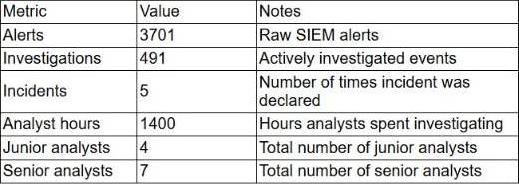
Which of the following is the best action to improve overall security operations efficiency?
Correct Answer: B
The most direct method for improving SOC efficiency when excessive alerts are non-actionable is to identify the detections generating that noise and perform rule and alert tuning. Non-actionable detections consume analyst time, increase queue depth, contribute to alert fatigue, and can obscure genuinely malicious activity. Tuning may include adjusting thresholds, refining correlation logic, adding exclusions for legitimate behavior, improving indicator context, modifying detection conditions, or disabling rules that consistently generate false positives without meaningful security value.
A cloud security posture management platform may improve context for cloud-related findings, but it does not directly correct poorly performing detection logic across the broader SOC. Playbooks improve consistency and reduce investigation variability, particularly for junior analysts, but they still force personnel to process alerts that should not have been generated. Training can improve analyst performance, yet it also fails to address the source of excessive non-actionable notifications.
The CS0-004 Security Operations objectives explicitly identify efficiency and process improvement, including standardized processes, automation and orchestration, data enrichment, rule/alert tuning, dashboard creation, and technology integration.
Therefore, the optimal operational improvement is to reduce unnecessary workload at the detection layer itself.
Study Guide Reference: Security Operations Efficiency and Process Improvement Data Enrichment Rule/Alert Tuning SOC Optimization.
A security analyst responds to an alert regarding identity and access management activity within the cloud environment. The attacker is currently trying to gain access from one isolated cloud subscription to another via a compromised user role.
Which of the following aspects of the MITRE ATT&CK framework is the attacker trying to perform?
Correct Answer: B
The attacker is attempting lateral movement because an already compromised identity is being used to move from one cloud environment or subscription into another. Lateral movement describes adversary activity intended to reach additional systems, services, accounts, or resources after an initial foothold has been established.
MITRE ATT&CK specifically includes cloud-oriented lateral movement. Its Lateral Movement tactic documents adversaries using valid accounts to access additional cloud services and resources within compromised environments. MITRE also documents cloud-role manipulation that may enable movement into additional accounts, demonstrating how identity and role relationships can become lateral-movement pathways in cloud architectures.
Privilege escalation would apply if the attacker were primarily attempting to obtain greater permissions within the current security context. Persistence concerns maintaining long-term access. Execution concerns running malicious code or commands. Credential access involves obtaining credentials or authentication material.
In this scenario, the attacker already possesses a compromised user role. The objective is to use that existing access to traverse a trust boundary and reach another isolated subscription. That movement between security domains is the decisive indicator of the Lateral Movement tactic.
Study Guide Reference: Security Operations MITRE ATT&CK Lateral Movement Cloud Services Valid Accounts IAM Roles Cross-Subscription Access.
Which of the following is the most important reason why tactics, techniques, and procedures (TTP) are beneficial to a defensive strategy?
Correct Answer: D
Tactics, techniques, and procedures represent the behavioral characteristics of an adversary rather than merely individual technical artifacts. A tactic describes the adversary's objective, a technique identifies how that objective is achieved, and procedures represent the specific implementation observed during an intrusion. Consequently, TTP intelligence allows defenders to understand how an attacker operates, including patterns of reconnaissance, persistence, privilege escalation, lateral movement, command-and-control activity, and other operational behaviors.
Options A and B focus primarily on indicators of compromise such as IP addresses and hashes. These are useful for detection, but they are comparatively fragile because attackers can replace infrastructure, change domains, regenerate malware, or modify files to produce different hashes. Option C is broader than an individual IoC, but tools can likewise be replaced or modified. Behavioral knowledge is generally more durable because changing established operational methods imposes greater cost on an adversary.
The CS0-004 objectives explicitly place TTPs, Pyramid of Pain, MITRE ATT&CK, attribution, IoC analysis, and behavioral indicators within threat intelligence and threat-hunting concepts.
Study Guide Reference: Security Operations Threat Intelligence and Threat Hunting TTPs Pyramid of Pain MITRE ATT&CK Behavioral IoCs.
An analyst uses an AI platform to help correlate events. The AI output contains events that did not happen. This results in inaccurate correlations.
Which of the following best describes what has occurred?
Correct Answer: A
The scenario describes an AI hallucination, commonly termed confabulation in formal AI risk-management literature. The defining characteristic is that the model produces information that appears plausible but is factually incorrect or unsupported. Here, the AI system introduces events that never occurred, contaminating the event-correlation process and potentially causing analysts to reach incorrect conclusions.
NIST's Generative AI Profile identifies confabulation as the production of confidently stated but erroneous or false content and treats it as an AI risk that requires verification and monitoring. NIST cybersecurity guidance also recognizes hallucination and confabulation as risks to information accuracy when AI is incorporated into cybersecurity workflows.
Data exposure would involve unauthorized disclosure of confidential or sensitive information. A malicious prompt involves intentionally crafted input designed to influence model behavior or bypass restrictions. Model poisoning occurs when an adversary manipulates training or model-related data to corrupt the system's behavior. None of these conditions is required in the scenario; the critical evidence is fabrication of nonexistent events.
Security analysts therefore must treat AI-generated correlation as analytical assistance rather than unquestioned evidence and validate important conclusions against authoritative logs and telemetry.
Study Guide Reference: Security Operations Artificial Intelligence AI Risks Hallucinations Data Exposure Malicious Prompts Model Poisoning Human Validation.
A public threat intelligence report includes indicators of compromise (IoCs) for threat actors. The threat actors are exploiting a zero-day vulnerability that the vendor has not fixed.
Which of the following techniques should be used until a patch is available?
Correct Answer: C
A zero-day vulnerability presents a special remediation problem because the affected organization may have confirmed exposure while no vendor patch is available. Until permanent remediation becomes possible, the organization should increase continuous monitoring for evidence that the vulnerability is being targeted or exploited. Threat-intelligence IoCs can be incorporated into SIEM, EDR, IDS/IPS, network monitoring, and threat-hunting workflows to identify suspicious connections, processes, authentication events, or other behaviors associated with the threat actor.
Continuous monitoring does not eliminate the vulnerability, but it strengthens detection capability during the exposure window and supports rapid containment if exploitation occurs. This approach should ordinarily be combined with available compensating controls such as segmentation, access restrictions, service disabling, configuration changes, or other vendor-recommended workarounds.
Sinkholing is primarily used to redirect malicious network traffic, particularly command-and-control or malicious-domain traffic, and is not a general solution for an unpatched zero-day. Eradication occurs after malicious artifacts or persistence mechanisms have been identified during incident response. Evidence acquisition is a forensic activity and does not reduce the immediate exploitation risk.
CS0-004 requires analysts to consider active exploitation/threat intelligence, patch/remediation availability, context, and compensating controls when prioritizing and mitigating vulnerabilities.
Study Guide Reference: Vulnerability Management Prioritization Active Exploitation Patch Availability Compensating Controls and Continuous Monitoring.
CS0-004 Exam Domains and Weightings
Domains and weightings follow CompTIA's published CySA+ V4 objectives.
Security Operations
34%System and network architecture, identity concepts, logging, indicators of malicious activity, and the tooling used to investigate them: SIEM, EDR, packet analysis, threat intelligence platforms. This version also adds AI in security operations, covering use cases, risks, and governance. The largest domain, and the one most changed since CS0-003.
Vulnerability Management
26%Scanning methods, interpreting assessment output, and prioritising remediation using scoring systems, threat intelligence, and business context. Cloud-native and hybrid environments now fall inside scope, so questions increasingly ask you to weigh a finding in a container or managed service rather than on a server.
Incident Response and Management
24%Attack methodology frameworks such as MITRE ATT&CK and the Cyber Kill Chain, the full incident response lifecycle, and hands-on techniques: triage, evidence handling, escalation, remediation, and root cause analysis. CompTIA has increased the emphasis on what happens during and after an incident.
Reporting and Communication
16%Vulnerability reports, dashboards, incident documentation, post-incident reviews, and metrics such as detection time and remediation effectiveness. The smallest domain, and the one technical candidates most often skip, which is why it produces disproportionate mark loss.
Official Revisions by CompTIA
23 June 2026 — : CS0-004 (V4) launched, replacing CS0-003. Domain weightings changed, AI in security operations was added to Security Operations, and cloud-native and hybrid environments entered incident scoping and vulnerability management.
22 December 2026 — : Scheduled retirement of the English CS0-003 exam. English learning products retire 22 November 2026.
23 March 2027 — : Scheduled retirement of CS0-003 translated exam versions.
Source: CompTIA's CySA+ certification pages. Our question bank is updated on its own cycle and re-checked against the published objectives when CompTIA revises them.
What the CS0-004 Exam Really Tests, and How
CompTIA writes CySA+ as an analyst exam, not a knowledge exam, and the objective verbs make that plain: analyse, implement, prioritise, outline. You are asked to work as though you were on shift, which shows up in four distinct question shapes.
Reading evidence and reaching a verdict
Tested via: performance-based questionsLog excerpts, SIEM output, packet captures, or scan results appear on screen and you determine what happened or what to do next. These items take far longer than multiple choice and typically sit at the start of the exam, which is where candidates lose time they need later.
Prioritising when everything looks urgent
Tested via: scenario-based multiple-choice questionsA list of vulnerabilities or alerts arrives with business context attached, and you rank or select what to address first. The deciding factor is rarely raw CVSS score: exploitability, asset criticality, and compensating controls are usually what the question actually turns on.
Applying a framework to an incident
Tested via: multiple-choice and multiple-response questionsItems place a described intrusion against MITRE ATT&CK or the Cyber Kill Chain, or ask which incident response phase a given action belongs to. Precision matters: containment and eradication activities are easy to conflate under time pressure.
Communicating findings to non-analysts
Tested via: scenario-based questionsReporting and Communication is 16% of the exam and reads differently from the rest. You choose what belongs in an executive summary, which metric answers a stakeholder's question, or how to escalate a finding. Technically strong candidates routinely underprepare for these.
How to Pass CS0-004 on Your First Attempt
CySA+ rewards analysts who already work the job, which cuts both ways: the instincts transfer, but so do the habits of a specific SOC. Two things sink first attempts, unfamiliarity with the performance-based items and running out of clock.
Sit a set cold and time it from the start. Because the performance-based questions dominate the early minutes, an untimed practice run teaches you nothing about your real risk. Start timing on the first attempt so the pacing problem shows up while you can still fix it.
Work each miss back to the objective it came from. CompTIA publishes granular objectives for V4. Map every wrong answer to its objective and read what the wording asks you to be able to do; the exam phrases items closely to that language, so the mapping pays off repeatedly.
Give Security Operations the largest share of your time. At 34% it is the biggest domain and carries the new AI content that no CS0-003 material covers. Vulnerability Management follows at 26%. Reporting and Communication is only 16%, but it is cheap to improve, so do not leave it at zero.
Practise finishing, not just answering. Eighty-five questions in 165 minutes is comfortable only if the performance-based items do not swallow the first hour. Run one full-length timed sitting, note where the clock got tight, and build your final review around that.
What to Look for in CS0-004 Practice Questions
and Why Prefer Pass4Success Practice Material
Rebooking CySA+ means paying for another voucher and waiting out CompTIA's retake policy. Against that cost, the price of practice material is secondary to whether it was written for V4 at all. These are the checks worth making.
Written for CS0-004, not converted from CS0-003
V4 changed the domain weightings and added AI content that V3 never covered. Converted material reads convincingly while missing entire objectives, which is the worst combination.
✓ Ours: the bank is maintained on a regular cycle against the published V4 objectives, with the current update date shown in the exam details above.
Includes analyst-style evidence questions
If every practice question is a four-option definition check, the performance-based portion of the real exam will be the first evidence you have read under time pressure.
✓ Ours: the questions bank includes performance-based and evidence-interpretation items, not just recall questions, and the practice test runs timed sessions, so pacing across the longer items is rehearsed.
Open to inspection before purchase
Security certifications attract more recycled dumps than most. Being able to look at real questions first is the simplest quality filter available to you.
✓ Ours: a free demo of both formats, the PDF and the practice test, with no payment required first.
Deep enough to expose a weak domain
Four domains cannot be assessed by a short sample, particularly when one of them is new. You need enough questions per domain to see where you actually stand.
✓ Ours: 82 CS0-004 questions across all four domains.
Worth less than a second voucher
The useful comparison is not between prep providers but between preparing once and buying a second exam voucher.
✓ Ours: Practice material costs $69 once, versus a second CompTIA exam voucher if you walk in underprepared. Prep costs less than a second attempt and a lot less than paying for the exam twice.
CS0-004 Exam Discussion: What Recent Candidates Say
Below, candidates who have sat CS0-004 since its June launch describe how the AI objectives were actually tested, how much of the clock the performance-based items consumed, and what they would prepare differently. If you have taken it, add what surprised you.
Ready to Pass CS0-004 on Your First Attempt?
Get Premium AccessFrequently Asked Questions
What skills are measured on the CS0-004 exam?
Four domains: Security Operations (34%), Vulnerability Management (26%), Incident Response and Management (24%), and Reporting and Communication (16%). V4 adds AI in security operations to the first domain and brings cloud-native and hybrid environments into incident scoping and vulnerability work.
What are the prerequisites for taking the CS0-004 exam?
CompTIA sets no mandatory prerequisite. It recommends around four years of hands-on experience as a SOC analyst or vulnerability analyst, and candidates commonly hold Security+ first. You can book CS0-004 without either.
How hard is the CS0-004 exam?
Demanding for anyone without operational experience. The performance-based questions require reading real evidence rather than recalling definitions, and the prioritisation items depend on judgement that is difficult to acquire from a book. Working analysts typically find it fair; career changers usually need lab time first.
What types of questions are on the CS0-004 exam?
Multiple choice, multiple response, and performance-based items where you work with logs, scan output, or simulated interfaces. The exam has a maximum of 85 questions in 165 minutes, and the performance-based questions consume disproportionately more of that time.
What are the most common mistakes on the CS0-004 exam?
Spending too long on the early performance-based items, prioritising vulnerabilities by CVSS score while ignoring the business context in the stem, confusing containment with eradication in incident response, and neglecting the reporting domain entirely. Assuming CS0-003 knowledge transfers fully is the newest and most costly error.
How do the CS0-004 topics connect in a real project workflow?
They follow a security operations shift. You monitor and detect in security operations, assess and prioritise what the scanners return, respond when something is confirmed, then document and report it to people who were not in the room. Exam scenarios frequently run across two of those stages in a single question.
What is an effective final-week review plan for CS0-004?
Prioritise Security Operations and Vulnerability Management, which together carry 60% of the exam, and make sure the AI objectives are genuinely covered rather than skimmed. Sit one timed full-length test midweek to check pacing on performance-based items, then review misses only. The final day suits framework refreshers such as ATT&CK tactics and incident response phases.
Is CS0-004 worth it in 2026?
For analysts and those moving into SOC roles, yes. CySA+ is widely recognised for defensive security positions and appears in the US Department of Defense 8570 and 8140 frameworks. Choosing V4 over the retiring V3 also gives the certification a longer useful life.
Should I take CS0-004 or the retiring CS0-003?
Take CS0-004 unless you are days from sitting CS0-003 with V3 material already learned. The English CS0-003 exam retires on 22 December 2026 and translated versions on 23 March 2027, so V3 offers a shrinking window and omits the AI and cloud content employers are now asking about.
Related CompTIA Certification Exams
Because CS0-004 is new, the review cycle for this bank matters more than usual: it runs on a fixed internal schedule rather than waiting for CompTIA to move, and early exam feedback tends to reshape emphasis long before any published objective changes. CompTIA has confirmed the V3 retirement dates but has issued no revisions to the V4 objectives so far; when it does, the affected questions and answers are re-checked against the published objectives on top of the scheduled pass. The date of the most recent pass appears in the exam details table above.