
Free Preparation Discussions
 MENU

Cisco 300-615 Exam Questions
- Cisco Certified Network Professional CCNP Certifications
- Cisco Certified Network Professional Data Center CCNP Data Center Certifications
- Cisco Specialist Certifications
- Topic 1: Troubleshoot ACI Security Domains And Role Mapping/ Troubleshoot Storage Security
- Topic 2: Troubleshoot Data Center Compute Security/ Troubleshooting Network Security
- Topic 3: Troubleshoot Integration Of Centralized Management/ Troubleshoot Routing Protocols
- Topic 4: Troubleshoot Firmware Upgrades, Packages, And Interoperability/ Troubleshoot Hardware Interoperability
- Topic 5: Fabric Binding And Port Security/ Troubleshoot Cisco Unified Computing System Blade Chassis
- Topic 6: Troubleshoot Automation And Scripting Tools/ Troubleshoot Application Centric Infrastructure
- Topic 7: Troubleshoot Fcoe Cisco Unified Fabric (FIP, DCB)/ Troubleshoot Packet Flow From Server To The Fabric
- Topic 8: First-Hop Security Such As Dynamic ARP, DHCP Snooping, And Port Security/ Troubleshoot Switching Protocols, Such As RSTP+, LACP, And Vpc
- Topic 9: Troubleshoot Firmware Upgrades, Packages, And Interoperability/ Troubleshoot Cisco Unified Computing System Rack Servers
- Topic 10: Fibre Channel Buffer Credit Starvation/ Switched Fabric Initialization/ Troubleshoot Overlay Protocols, Such As VXLAN EVPN And OTV
- Topic 11: Troubleshoot Programmability/ Troubleshoot Fibre Channel/ Infrastructure Such As Chassis, Power, IOM
- Topic 12: Bash Shell And Guest Shell For NX-OS/ Troubleshoot Key Management/ Management And Operations/ Troubleshoot AAA And RBAC
Free Cisco 300-615 Exam Actual Questions
Note: Premium Questions for 300-615 were last updated On Oct. 17, 2026 (see below)
Refer to the exhibit.
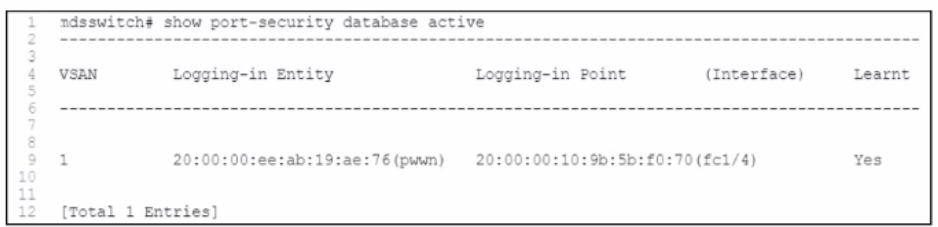
Refer to the exhibit. A SAN engineer must enforce the port security configuration database in Fibre Channel fabric that uses Cisco MDS 9000 Switches. Port security is enabled on the VSAN to which the port belongs. However, the rogue host can still log in to the fabric. Which Cisco MDS command resolves the issue?
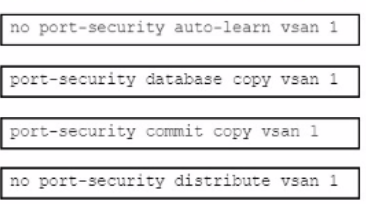
The correct answer is Option A. Cisco MDS and Nexus SAN troubleshooting is driven by fabric state: the host and target must be in the correct VSAN, must complete FLOGI/PLOGI where applicable, and must be permitted by active zoning, fcdomain, FSPF, NPV/NPIV, or port-security policy. This question focuses on MDS, VSAN, port security, so the selected action fixes the dependency that prevents the initiator, target, or inter-switch link from becoming usable. Cisco documentation emphasizes checking VSAN membership, active zonesets, correct port mode, fabric binding, device-alias consistency, and the relevant FC databases before changing unrelated server settings. The distractors either target a different database, use the wrong port role, or would not cause the observed Fibre Channel state to change. After the fix, the engineer should confirm the interface state, FLOGI database, name-server entries, zoneset activation, and successful initiator-to-target reachability with tools such as fcping or fabric show commands.
Refer to the exhibit.

The EEM applet generates an SNMP string every time a user executes the show ip route command After the applet was deployed, other engineers reported that they can no longer use the show ip route command to view the routing information. Which action resolves the issue?
The selected option, Add the event -default action statement to the end of the script, is correct for the automation path described. Cisco NX-OS requires precision in EEM applets, scheduler jobs, Guest Shell operations, and REST/NX-API syntax. The affected element is EEM, SNMP; therefore, the fix must be applied to the component that actually executes the action. For EEM, that means a valid event detector and explicit actions, with event-default when the matched CLI command should continue. For Guest Shell and Bash, DNS, proxy, resource allocation, and reboot behavior are local to the Linux container. For REST calls, the class name, method, authentication, and XML/JSON structure must match the APIC or NX-OS object model. The distractors usually change the switch globally or alter an unrelated command. Cisco DCIT automation troubleshooting confirms the fix by checking the returned error, then rerunning the exact job, script, or API operation in the same context.
Refer to the exhibit.
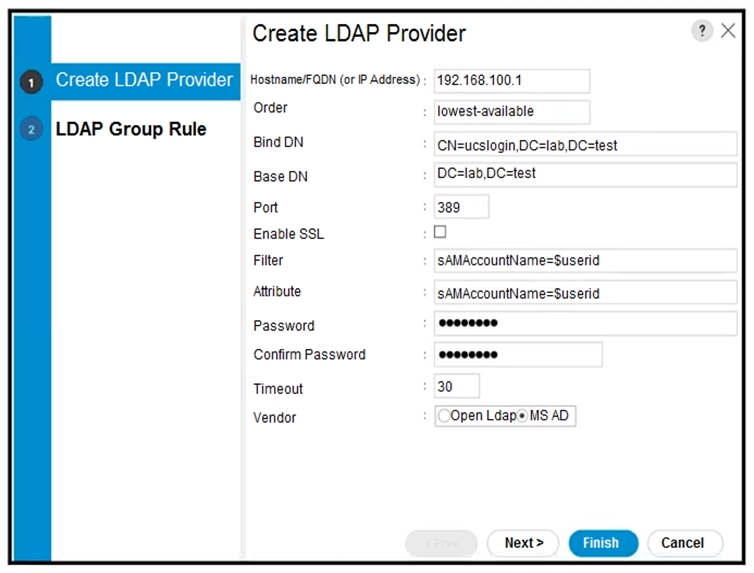
Refer to the exhibit. A network engineer configures an authentication domain through an LDAP provider on the Cisco UCS Manager for users from different companies to log into their respective organizations created in the UCS Manager. The engineer tests the configuration and notices that any user has login access to any organization in the UCS Manager. Which action should be taken to resolve the issue?
Configure the Filter field with sAMAccountName=$company is the appropriate UCS remediation because the symptom maps to a specific managed object rather than a generic server failure. Cisco UCS abstracts hardware through service profiles and policies; therefore, issues involving UCS, UCS Manager, LDAP must be corrected where UCS Manager programs the adapter, boot target, firmware, management certificate, pool qualification, or fabric interconnect state. The selected answer restores that programming path. The other options may appear plausible, but they do not correct the object that UCS uses to derive operational state. For example, boot failures require the correct vHBA/iSCSI target and LUN policy, discovery issues require the proper physical and management path, and firmware failures require the documented recovery action for the failed FSM stage. The correct validation is to inspect the associated fault, confirm inventory acknowledgment, verify the policy under the service profile or equipment tree, and then recheck boot or connectivity behavior after the FSM completes.
Refer to the exhibit.
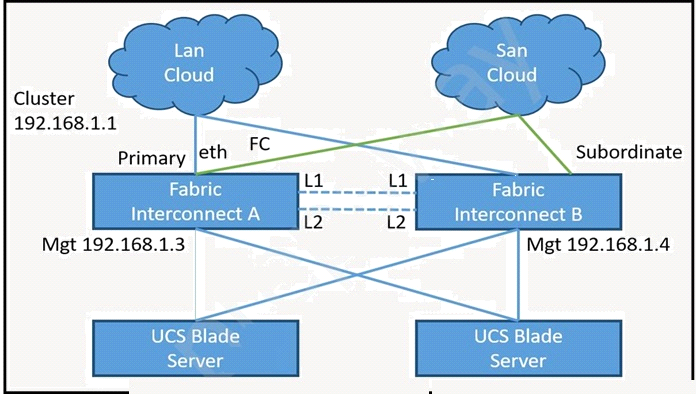
A network engineer finds one of the fabric interconnects offline when connecting L1 and L2 ports on both fabric interconnects. Which action resolves the issue?
Refer to the exhibit.
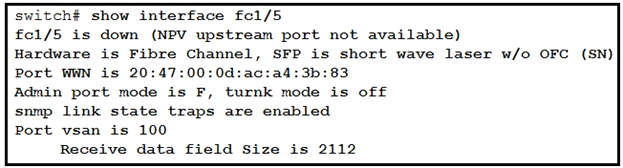
Interface fc1/5 is offline. Which action should be taken to troubleshoot the issue?
- Select Question Types you want
- Set your Desired Pass Percentage
- Allocate Time (Hours : Minutes)
- Create Multiple Practice tests with Limited Questions
- Customer Support
Ronald Davis
28 days agoAmy Hernandez
1 month agoJennifer Anderson
2 months agoBarbara Nelson
2 months agoElizabeth Harris
3 months agoGeorge Turner
3 months agoCharles Bell
4 months agoStephen Mitchell
4 months agoKaren Ramirez
5 months agoAndrew Scott
5 months agoTiffany Turner
6 months agoMelissa Adams
6 months agoJoseph Howard
6 months agoGeorge Lee
5 months agoDeborah Carter
5 months agoLouis
7 months agoKristeen
7 months agoTrevor
7 months agoLeatha
7 months agoColette
8 months agoMelissa
8 months agoLauran
8 months agoSherrell
8 months agoClaudia
9 months agoThora
9 months agoTiffiny
9 months agoSina
9 months agoHerman
10 months agoCyril
10 months agoBong
10 months agoMaurine
10 months agoLynette
11 months agoRashida
11 months agoMaurine
11 months agoMiles
11 months agoFlorencia
12 months agoGearldine
12 months agoBobbie
1 year agoNada
1 year agoLuis
1 year agoFletcher
1 year agoHubert
1 year agoDerick
1 year agoJimmie
1 year agoEulah
1 year agoJose
1 year agoJosephine
1 year agoMose
1 year agoXuan
2 years agoAlonzo
2 years agoDorthy
2 years agoNoel
2 years agoLeah
2 years agoRomana
2 years agoVeronika
2 years agoLizette
2 years agoAdrianna
2 years agoJohana
2 years agoShonda
2 years agoShenika
2 years agoJulie
2 years agoAmina
2 years agoLelia
2 years agoMaryann
2 years agoElvera
2 years agoPrecious
2 years agoVicki
2 years agoYolande
2 years agoShay
2 years agoStefany
2 years agoStephen
2 years agoLasandra
2 years agoAmira
2 years agoSabina
2 years agoLenna
2 years agoIzetta
2 years agoLashawn
2 years agoPete
2 years agoTerry
2 years agoLashawna
2 years agoDorthy
2 years ago