
Free Preparation Discussions
 MENU
MENU
Cisco 200-901 Exam Questions
- Cisco Certified Network Associate CCNA Certifications
- Cisco Certified Network Associate Automation CCNA Automation Certifications
- Topic 1: Software Development and Design: The topic covered include data formats (XML, JSON, and YAML), how to explain parsing of common data format (XML, JSON, and YAML) to Python data structures, describe the concepts of test-driven development, the contrast between various software development techniques such as waterfall or agile, and describing the advantages of organizing code into methods/functions, classes, and modules. Moreover, the topics covered include clone, add or remove, commit, push or pull, and merge conflicts.
- Topic 2: Understanding and Using APIs: The topics in this domain of the exam including how to construct a REST API request to accomplish a task given API documentation, define common usage patterns related to webhooks, pinpoint the constraints when consuming APIs, explain common HTTP response codes associated with REST APIs, troubleshooting an issue for given the HTTP response code and pinpointing the parts of an HTTP response.
- Topic 3: Cisco Platform and Development: In this module, the topics covered include how to create a Python script that uses a Cisco SDK given SDK documentation, define the capabilities of Cisco network management platforms and APIs (Meraki, Cisco DNA Center, ACI, Cisco SD-WAN, and NSO), explain the skills related to Cisco compute management platforms and APIs, describe the capabilities of Cisco collaboration platforms and APIs such as Webex, Webex devices, Cisco Unified Communication Manager including AXL and UDS interfaces, and explaining the capabilities of Cisco security platforms and APIs.
- Topic 4: Application Deployment and Security: In this section, the advantages of edge computing are defined in addition to identifying attributes of different application deployment frameworks. It also covers how to identify the attributes of these application deployment types, virtual machines, bare metal, and containers. More topics covered include how to describe elements for a CI/CD pipeline in application deployments, construct a Python unit test, interpret contents of a Dockerfile, use Docker images in a local developer environment, and to identify application security issues related to secret protection, encryption (storage and transport), and data handling.
- Topic 5: Infrastructure and Automation: The topics covered include how to describe the value of model-driven programmability for infrastructure automation, compare controller-level to device-level management, describe the use and roles of network simulation and test tools, explain the components and benefits of CI/CD pipeline in infrastructure automation, define foundations of infrastructure as code, the skills related to automation tools such as Ansible, Terraform, and Cisco NSO, identify the workflow being automated by a Python script. Moreover, the topics include how to pinpoint the workflow being automated by an Ansible playbook, pinpoint the workflow being automated by a bash script, interpret the outcomes of a RESTCONF or NETCONF query, YANG models, and a unified diff.
- Topic 6: Networking Fundamentals: The topics covered include how to explain the purpose and usage of MAC addresses and VLANs, the purpose and usage of IP addresses, routes, subnet mask/prefixes, and gateways. It also covers topics such as explaining the function of switches, routers, firewalls, and load balancers and analyzes a basic network topology diagram with switches, routers, firewalls, load balancers, and port values. The topics also include the function of management, data, and control planes in a network device, the functionality of these IP Services: DHCP, DNS, NAT, SNMP, NTP, recognize common protocol port values including SSH, Telnet, HTTP, HTTPS, and NETCONF, and how to pinpoint the cause of application connectivity problems related to NAT, proxy, and VPN.
Free Cisco 200-901 Exam Actual Questions
Note: Premium Questions for 200-901 were last updated On Aug. 26, 2026 (see below)
What should a CI/CD pipeline aim to achieve?
A CI/CD (Continuous Integration/Continuous Deployment) pipeline aims to automate the process of integrating code changes, testing them, and deploying them to production with minimal manual intervention. This automation improves efficiency, reduces errors, and ensures consistency across deployments. The key goal is to streamline and expedite the software development lifecycle by allowing developers to focus more on coding and less on the deployment process. Manual interaction is minimized to maintain the flow and reliability of the pipeline. Reference: Cisco DevNet Associate Certification Guide, Chapter 5, Section on CI/CD Pipelines.
Refer to the exhibit.
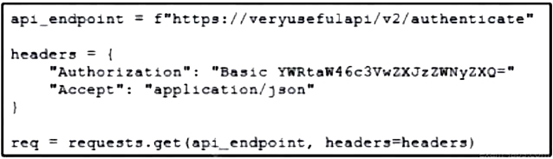
A developer is part of a team that is working on an open-source project in which source code is hosted in a public GitHub repository. While the application was built, security concerns were addressed by encrypting the credentials on the server. After a few months, the developer realized that a hacker managed to gain access to the account. The exhibit contains part of the source code for the login process. Why was the attacker able to access the developer's account?
The exhibit shows that the credentials are base64 encoded and included in the source code. Base64 encoding is not a secure method of protecting credentials as it can be easily decoded. Therefore, an attacker who gains access to the source code can decode the credentials and gain unauthorized access to the account. Proper security practices should involve storing credentials securely, such as using environment variables or secure vaults, and not hardcoding them in the source code.
OWASP - Storing Passwords Securely
Cisco DevNet Associate Certification Guide
A company wants to automate the orders processed on its website using API. The network device that supports the solution must:
support XML encoding
support distributed transactions
support YANG data models
be support software redundancy
Which requirement prevents the use of RESTCONF for the solution?
RESTCONF is a protocol used to access data defined in YANG using standard HTTP methods. However, it does not support distributed transactions, which is a requirement in this scenario.
RESTCONF: Supports YANG data models, XML encoding, and can be used in environments with software redundancy.
Distributed Transactions: RESTCONF does not support distributed transactions, which require coordination of a transaction across multiple network devices or components.
Option C is correct as the requirement for distributed transactions prevents the use of RESTCONF.
Cisco DevNet Documentation: RESTCONF Protocol
Refer to the exhibit.
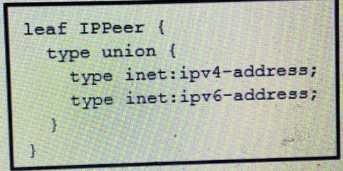
What is the value of the node defined by this YANG structure?
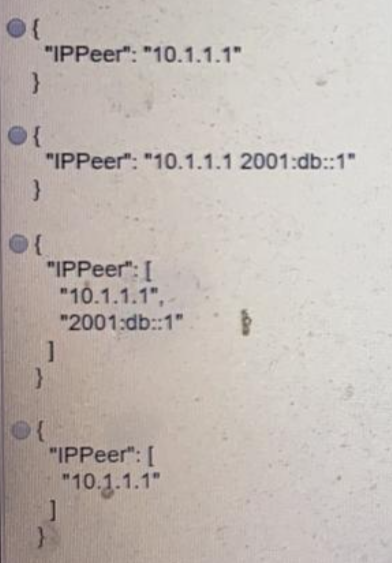
The YANG structure shown defines a leaf IPPeer that can be either an IPv4 address or an IPv6 address. The third JSON example correctly represents this union type by using an array with both possible types included:
'IPPeer': [
'10.1.1.1',
'2001:db::1'
]
}
This correctly reflects the YANG definition, where IPPeer can be either type specified in the union.
YANG - Data Modeling Language
Cisco YANG Models
Access to the management interface of devices must be restricted by using SSH and HTTPS. Which two ports must be included in the ACLs for the protocols to work? (Choose two.)
To restrict access to the management interface of devices using SSH and HTTPS, the correct ports need to be included in the ACLs.
Port 22: Used by SSH (Secure Shell) for secure remote login and command execution.
Port 443: Used by HTTPS (Hypertext Transfer Protocol Secure) for secure web traffic.
Options A and D are correct as they are the standard ports for SSH and HTTPS.
Cisco Security Documentation: Common Ports
- Select Question Types you want
- Set your Desired Pass Percentage
- Allocate Time (Hours : Minutes)
- Create Multiple Practice tests with Limited Questions
- Customer Support
Deborah Bell
8 days agoMaria Johnson
30 days agoThomas Robinson
1 month agoCarol Young
2 months agoKenneth Flores
2 months agoRichard Gonzalez
3 months agoRonald Perez
3 months agoRichard Miller
4 months agoEmma Nelson
4 months agoRebecca Hall
4 months agoMelissa Edwards
4 months agoBetty Thomas
4 months agoJustin Carter
4 months agoHarold Sanchez
4 months agoHailey
5 months agoCarrol
5 months agoHoa
5 months agoLera
6 months agoAltha
6 months agoHana
6 months agoBuck
6 months agoMargurite
7 months agoDawne
7 months agoVerdell
7 months agoGeorgeanna
7 months agoMelvin
8 months agoRaymon
8 months agoMona
8 months agoKristeen
8 months agoVincenza
9 months agoChaya
9 months agoOneida
9 months agoLizette
9 months agoSharmaine
10 months agoDonette
10 months agoNickolas
10 months agoJennifer
10 months agoMarya
11 months agoCheryll
11 months agoClaribel
11 months agoJoseph
11 months agoGretchen
12 months agoCathrine
12 months agoDenny
1 year agoMarg
1 year agoJolene
1 year agoBarbra
1 year agoGail
2 years agoChau
2 years agoRickie
2 years agoKarol
2 years agoAdelina
2 years agoAdelina
2 years agoWilliam
2 years agoRodolfo
2 years agoDetra
2 years agoLenita
2 years agoElliot
2 years agoEmiko
2 years agoErnie
2 years agoDylan
2 years agoAlaine
2 years agoCasie
2 years agoYong
2 years agoLuis
2 years agoArlene
2 years agoJohnathon
2 years agoMaddie
2 years agoYoko
2 years agoLavera
2 years agoVirgina
2 years agoLeonardo
2 years agoRomana
2 years ago