Deal of The Day! Hurry Up, Grab the Special Discount - Save 25% - Ends In 00:00:00 Coupon code: SAVE25

Welcome to Pass4Success

- Free Preparation Discussions

Cisco 350-501 Exam - Topic 4 Question 116 Discussion

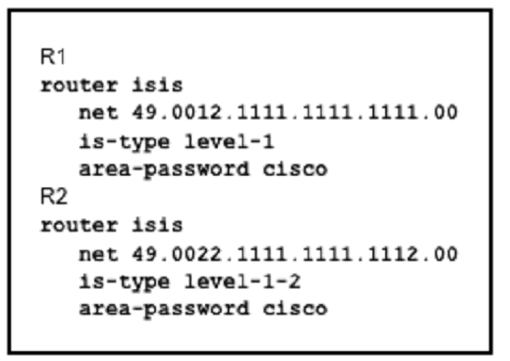
Refer to the exhibit:What is the effect of this configuration?
B) The two routers successfully form a neighbor relationship
A) The two routers fail to form a neighbor relationship because their system IDs are different.
C) The two routers fail to form a neighbor relationship because the authentication configuration is missing
D) The two routers fail to form a neighbor relationship because they have different ISIS area types.

Cisco 350-501 Exam - Topic 4 Question 116 Discussion

Actual exam question for Cisco's 350-501 exam
Question #: 116
Topic #: 4
[All 350-501 Questions]

Refer to the exhibit:

What is the effect of this configuration?

Show Suggested Answer Hide Answer
Suggested Answer: B

In ISIS, routers can form neighbor relationships even with different system IDs, provided they are configured to be in the same area and the authentication between them is correctly set up.


Contribute your Thoughts:

0/2000 characters
Delisa
8 months ago
Wait, are you saying different system IDs alone can cause this? That's wild!
upvoted 0 times
...
Stephaine
8 months ago
I thought authentication issues would be the main problem here.
upvoted 0 times
...
Galen
9 months ago
Totally agree, that's a basic rule in networking!
upvoted 0 times
...
Simona
9 months ago
A is correct, different system IDs will prevent neighbor formation.
upvoted 0 times
...
Adaline
9 months ago
D seems plausible too, but I think A is the main reason.
upvoted 0 times
...
Jarod
9 months ago
I thought they could still form a relationship even with different system IDs, but I could be wrong. Maybe option B is possible?
upvoted 0 times
...
Linwood
10 months ago
I practiced a similar question where area types affected neighbor relationships, so I’m leaning towards option D.
upvoted 0 times
...
Lazaro
10 months ago
I’m not entirely sure, but I feel like the authentication part could be a factor. Maybe option C?
upvoted 0 times
...
Karl
10 months ago
I remember something about system IDs being crucial for forming neighbor relationships, so I think option A might be correct.
upvoted 0 times
...
Oliva
10 months ago
This is a good test of my ISIS knowledge. I'll methodically analyze each answer choice and eliminate the ones that don't fit the given configuration.
upvoted 0 times
...
Amber
11 months ago
I'm a little confused by the authentication part of the question. Does that play a role in the neighbor relationship, or is that a red herring? I'll need to double-check the ISIS protocol requirements.
upvoted 0 times
...
Rodrigo
11 months ago
Okay, I've got this. The key here is to focus on the system ID and area type settings. If those don't match, the routers won't be able to form a neighbor relationship.
upvoted 0 times
...
Annmarie
11 months ago
Hmm, I'm a bit unsure about this one. The configuration seems to be missing some key details, so I'll need to think through the possible scenarios carefully.
upvoted 0 times
...
Chau
11 months ago
This looks like a pretty straightforward question about ISIS neighbor relationships. I'll carefully review the configuration details and compare them to the answer choices.
upvoted 0 times
...
Nu
11 months ago
I'm going with option B. How hard can it be to get two routers to talk to each other? They're practically made for it!
upvoted 0 times
...
Cordelia
11 months ago
I think D is the correct answer, different ISIS area types would cause a failure.
upvoted 0 times
...
Lynette
12 months ago
Hmm, I don't know about that. Maybe the authentication is missing, that would also cause issues. Though I guess the area type difference could be the real culprit here.
upvoted 0 times
Leonardo
8 months ago
Yeah, if the area types don’t match, they won't connect.
upvoted 0 times
...
Hobert
8 months ago
Both could cause problems, but I lean towards the area type.
upvoted 0 times
...
Carin
8 months ago
True, but the area type difference might be more critical.
upvoted 0 times
...
Hui
9 months ago
I think the authentication issue is a big factor.
upvoted 0 times
...
...
Fernanda
1 year ago
I'm leaning towards C, missing authentication could be the issue.
upvoted 0 times
...
Kristel
1 year ago
I disagree, I believe the answer is B.
upvoted 0 times
...
Tawna
1 year ago
I think the answer is A.
upvoted 0 times
...
Micheline
1 year ago
The routers definitely can't form a neighbor relationship with different system IDs. That's just basic ISIS 101, man.
upvoted 0 times
Theodora
1 year ago
A) The two routers fail to form a neighbor relationship because their system IDs are different.
upvoted 0 times
...
...

Save Cancel