Deal of The Day! Hurry Up, Grab the Special Discount - Save 25% - Ends In 00:00:00 Coupon code: SAVE25
Welcome to Pass4Success

- Free Preparation Discussions

Cisco 350-101 Exam - Topic 1 Question 7 Discussion

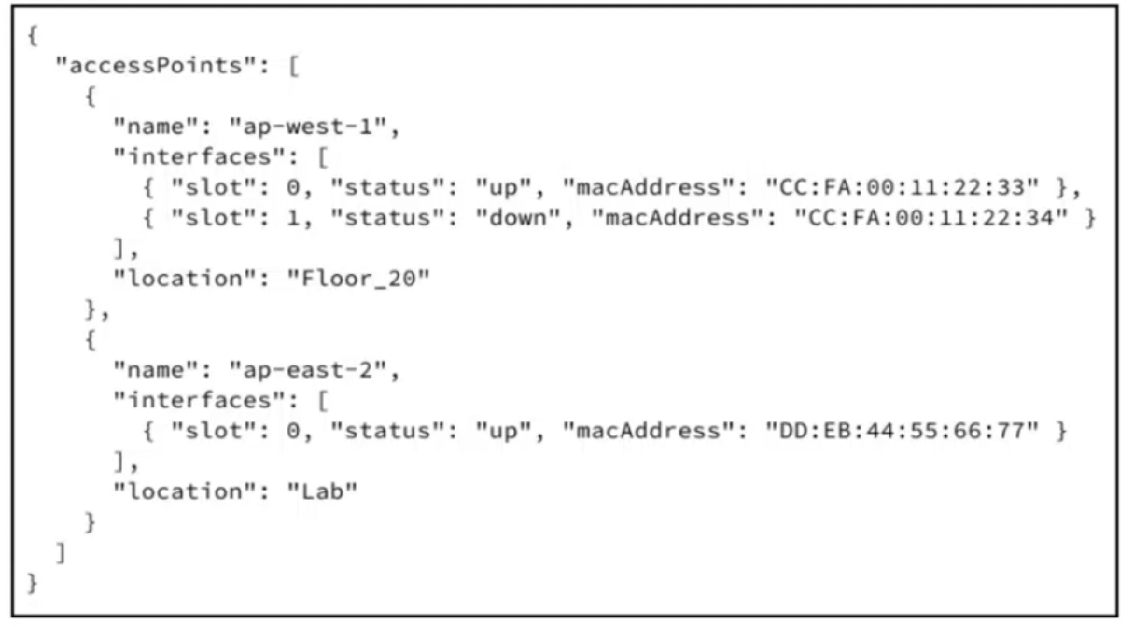
Refer to the exhibit.Refer to the exhibit. A JSON response from a wireless management API contains access point inventory and interface state information. Which JSON expression retrieves the MAC address of the second interface on the first access point?
A) accessPoints[0].interfaces[1].macAddress
B) accessPoints[1].interfaces[0].macAddress
C) accessPoints[0].interfaces[0].macAddress
D) accessPoints[1].interfaces[1].macAddress

Cisco 350-101 Exam - Topic 1 Question 7 Discussion

Actual exam question for Cisco's 350-101 exam
Question #: 7
Topic #: 1
[All 350-101 Questions]

Refer to the exhibit.

Refer to the exhibit. A JSON response from a wireless management API contains access point inventory and interface state information. Which JSON expression retrieves the MAC address of the second interface on the first access point?

Show Suggested Answer Hide Answer
Suggested Answer: A

The correct expression is accessPoints[0].interfaces[1].macAddress. The JSON object contains a top-level key named accessPoints, whose value is an array. Array indexing begins at zero, so accessPoints[0] selects the first access point object, ap-west-1. Inside that object, the interfaces key also contains an array. Therefore, interfaces[1] selects the second interface object, which has slot: 1, status: 'down', and macAddress: 'CC:FA:00:11:22:34'. The final selector, .macAddress, returns that MAC address value.

This structure is directly aligned with Cisco automation workflows, where RESTCONF and Catalyst Center APIs exchange structured data in JSON. Cisco documents that Catalyst Center REST API payloads are JSON-formatted, and its example describes JSON as key-value data separated by colons. Cisco also states that Catalyst 9800 RESTCONF uses structured XML or JSON with YANG models for programmatic device access. Option B selects ap-east-2. Option C selects the first interface on ap-west-1. Option D references a non-existent second interface on ap-east-2. Reference topics: Automation and AI --- JSON parsing, REST APIs, Catalyst Center programmability, RESTCONF, and wireless telemetry data structures.


Contribute your Thoughts:

0/2000 characters
Paola
3 days ago
Right, we need the first access point.
upvoted 0 times
...
Marisha
8 days ago
B is wrong. It’s the second access point.
upvoted 0 times
...
Alex
13 days ago
I feel confused. Why not B?
upvoted 0 times
...
Jospeh
19 days ago
Agreed, A makes sense. Index starts at 0.
upvoted 0 times
...
Paola
24 days ago
I think it's A. First access point, second interface.
upvoted 0 times
...
Louvenia
29 days ago
I don’t get why it wouldn’t be D. Seems like a trick question!
upvoted 0 times
...
Johnna
1 month ago
Wait, are we sure it’s not C? That seems plausible too.
upvoted 0 times
...
Jettie
1 month ago
A is correct, no doubt about it!
upvoted 0 times
...
Merissa
1 month ago
I think it’s B, but I’m not sure.
upvoted 0 times
...
Lenita
2 months ago
It's definitely A! First AP, second interface.
upvoted 0 times
...
Gertude
2 months ago
I feel like I’ve seen options like this before, but I can't recall if it was about interfaces or something else.
upvoted 0 times
...
Nakisha
2 months ago
I’m a bit confused about whether the first access point is indexed as 0 or 1. I hope I got that right.
upvoted 0 times
...
Isadora
2 months ago
I remember practicing a similar question where we had to access nested JSON data. I think it was something like accessPoints[0].interfaces[1].
upvoted 0 times
...
Earleen
2 months ago
I think the answer might be A, but I'm not completely sure about the indexing.
upvoted 0 times
...

Save Cancel