Deal of The Day! Hurry Up, Grab the Special Discount - Save 25% - Ends In 00:00:00 Coupon code: SAVE25

Welcome to Pass4Success

- Free Preparation Discussions

Cisco 300-815 Exam - Topic 8 Question 64 Discussion

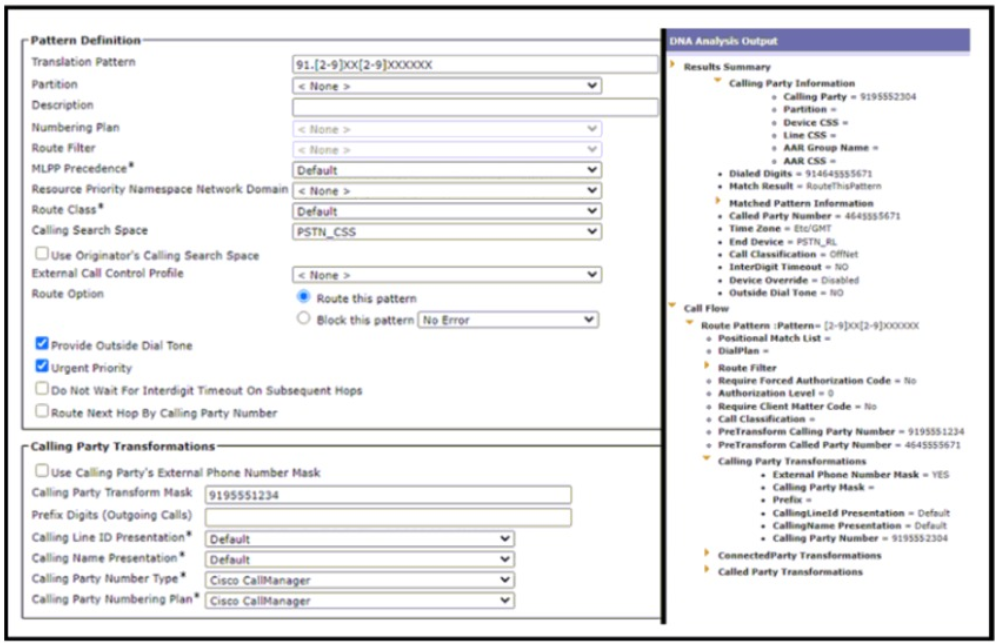
Refer to the exhibit.For long-distance calls, users must prefix their dialed number with ''91.'' The translation pattern was created to strip the 91 as the PSTN expects a 10- digit number. The PSTN also requires the calling number to be set to 9195551234. However, the service provider has said calls with a different calling number are being received. How is this issue resolved?
C) Disable Use Calling Party's External Phone Number Mask on the route pattern.
A) Change the partition of the translation pattern from none to pstn_pt.
B) Enable Force Authorization Code on the route pattern.
D) Enable Use Calling Party's External Phone Number Mask on the translation pattern.

Cisco 300-815 Exam - Topic 8 Question 64 Discussion

Actual exam question for Cisco's 300-815 exam
Question #: 64
Topic #: 8
[All 300-815 Questions]

Refer to the exhibit.

For long-distance calls, users must prefix their dialed number with ''91.'' The translation pattern was created to strip the 91 as the PSTN expects a 10- digit number. The PSTN also requires the calling number to be set to 9195551234. However, the service provider has said calls with a different calling number are being received. How is this issue resolved?

Show Suggested Answer Hide Answer
Suggested Answer: C

Contribute your Thoughts:

0/2000 characters
Hoa
10 months ago
Why would the service provider accept different numbers? That's odd!
upvoted 0 times
...
Catrice
10 months ago
Disagree, I feel like changing the partition is the way to go.
upvoted 0 times
...
Miesha
10 months ago
Wait, are we sure the calling number is the issue?
upvoted 0 times
...
Louvenia
11 months ago
I think option D makes the most sense here.
upvoted 0 times
...
Margurite
11 months ago
Calls need the "91" prefix for long-distance.
upvoted 0 times
...
Timmy
11 months ago
I think the issue might be with the route pattern settings, but I'm not confident if force authorization codes would actually resolve the calling number problem.
upvoted 0 times
...
Celestina
11 months ago
I feel like enabling the external phone number mask could help, but I can't recall the exact implications of that setting on the translation pattern.
upvoted 0 times
...
Anthony
11 months ago
This seems similar to a practice question we did about calling party settings. I think disabling the external phone number mask might be the right move here.
upvoted 0 times
...
Jacob
11 months ago
I remember we discussed translation patterns in class, but I'm not entirely sure how changing the partition affects the calling number.
upvoted 0 times
...
Harris
11 months ago
I'm a bit confused by the last few options. I'm not sure if a connection string can refer to multiple database instances or if the SID needs to be included. I'll have to think this through carefully.
upvoted 0 times
...
Whitley
11 months ago
This seems like a straightforward question. I'll focus on understanding the key differences between relational and non-relational databases to determine the correct answer.
upvoted 0 times
...
Lura
11 months ago
This one seems pretty straightforward. I'm pretty confident the answer is A - Trusted computing base (TCB).
upvoted 0 times
...
Audrie
11 months ago
I'm pretty sure routers operate at the network layer, so I'll go with B.
upvoted 0 times
...
Edelmira
11 months ago
Okay, I think I've got it. We need to use the map() method to extract the techName property, and then call forEach() to print each one. The answer should be B.
upvoted 0 times
...
Lynna
1 year ago
I'm leaning towards option A. Changing the partition of the translation pattern to 'pstn_pt' might be the way to go, but I'm curious to hear what the other candidates think.
upvoted 0 times
Stephane
1 year ago
I'm not sure, but maybe enabling the use of the external phone number mask could help.
upvoted 0 times
...
Elenora
1 year ago
I would go with option C, disabling the external phone number mask.
upvoted 0 times
...
Herman
1 year ago
I agree, changing the partition to 'pstn_pt' makes sense.
upvoted 0 times
...
Annamae
1 year ago
I think option A is the best choice.
upvoted 0 times
...
...
Glory
1 year ago
Haha, I bet the service provider is just trying to mess with the PSTN. Let's go with option D and see if that sorts out this 'different calling number' issue.
upvoted 0 times
Tawna
1 year ago
User 3: I think option D might be the solution to the issue.
upvoted 0 times
...
Alyce
1 year ago
User 2: Good idea, let's see if that fixes the problem.
upvoted 0 times
...
Mozell
1 year ago
User 1: Haha, I agree! Let's try option D.
upvoted 0 times
...
...
Val
1 year ago
Option C looks promising, but I'm not sure if disabling the 'Use Calling Party's External Phone Number Mask' on the route pattern is the right approach here. Shouldn't we be focusing on the translation pattern instead?
upvoted 0 times
Johnson
1 year ago
C) Disable Use Calling Party's External Phone Number Mask on the route pattern.
upvoted 0 times
...
Burma
1 year ago
B) Enable Force Authorization Code on the route pattern.
upvoted 0 times
...
Chantell
1 year ago
A) Change the partition of the translation pattern from none to pstn_pt.
upvoted 0 times
...
...
Jess
1 year ago
I think option D is the correct answer. Enabling the 'Use Calling Party's External Phone Number Mask' on the translation pattern will ensure that the calling number is set to the expected format of 9195551234.
upvoted 0 times
...
Emilio
1 year ago
But wouldn't disabling Use Calling Party's External Phone Number Mask on the route pattern also fix the issue?
upvoted 0 times
...
Santos
1 year ago
I disagree, I believe enabling Force Authorization Code on the route pattern would be the solution.
upvoted 0 times
...
Emilio
1 year ago
I think the issue can be resolved by changing the partition of the translation pattern to pstn_pt.
upvoted 0 times
...

Save Cancel