Deal of The Day! Hurry Up, Grab the Special Discount - Save 25% - Ends In 00:00:00 Coupon code: SAVE25

Welcome to Pass4Success

- Free Preparation Discussions

Cisco 300-620 Exam - Topic 1 Question 110 Discussion

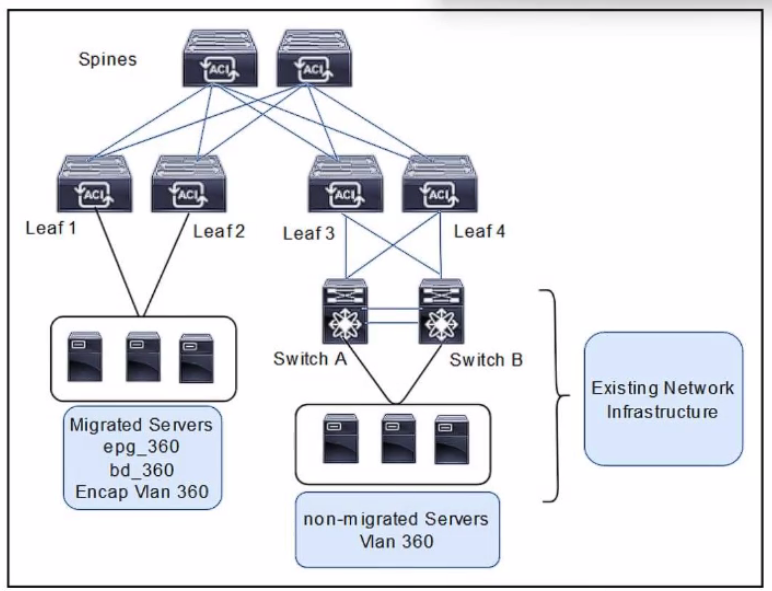
Refer to the exhibit.Refer to the exhibit. An engineer is migrating legacy servers into the Cisco ACI environment. The requirement is to ensure that all endpoints and MAC addresses are learned properly in legacy and Cisco ACI switches. Which configuration set must be configured under the bridge domain called bd__360 to accomplish this goal?
D) L2 Unknown Unicast: Flood ARP Flooding: Enabled
A) L2 Unknown Unicast: Hardware Proxy ARP Flooding: Disabled
B) L2 Unknown Unicast: Hardware Proxy ARP Flooding: Enabled
C) L2 Unknown Unicast: Flood ARP Flooding: Disabled

Cisco 300-620 Exam - Topic 1 Question 110 Discussion

Actual exam question for Cisco's 300-620 exam
Question #: 110
Topic #: 1
[All 300-620 Questions]

Refer to the exhibit.

Refer to the exhibit. An engineer is migrating legacy servers into the Cisco ACI environment. The requirement is to ensure that all endpoints and MAC addresses are learned properly in legacy and Cisco ACI switches. Which configuration set must be configured under the bridge domain called bd__360 to accomplish this goal?

Show Suggested Answer Hide Answer
Suggested Answer: D

Contribute your Thoughts:

0/2000 characters
Son
3 days ago
I think D is the most effective for all endpoints. Flooding is key!
upvoted 0 times
...
Ronna
8 days ago
I’m not sure. C seems like a safe option, but I doubt it’s the best.
upvoted 0 times
...
Carmela
13 days ago
I agree with Margurite. B ensures proper learning in both environments.
upvoted 0 times
...
Bok
19 days ago
I’m leaning towards A. Disabling flooding seems safer.
upvoted 0 times
...
Sylvia
24 days ago
I feel like D could work too. Flooding might help with learning.
upvoted 0 times
...
Margurite
29 days ago
This question is tricky! I think B is the right choice.
upvoted 0 times
...
Stephane
1 month ago
I’m not so sure about that. Could it really be B? Seems too straightforward.
upvoted 0 times
...
Danica
1 month ago
Surprised this is even a question! I thought everyone knew it's B.
upvoted 0 times
...
Tawna
1 month ago
Just to clarify, isn't this about ensuring proper MAC address learning?
upvoted 0 times
...
Margot
2 months ago
I disagree, I believe D is the right choice. Flooding should be enabled.
upvoted 0 times
...
Kiley
2 months ago
I think it's B for sure. Hardware Proxy ARP Flooding needs to be enabled.
upvoted 0 times
...
Karon
2 months ago
Wait, why would you need ARP flooding at all? Sounds risky!
upvoted 0 times
...
Ryan
2 months ago
C seems safer, but I guess it depends on the setup.
upvoted 0 times
...
Jestine
2 months ago
I’m not so sure about that, isn’t there a risk with enabling it?
upvoted 0 times
...
Annette
4 months ago
Definitely agree with B, that’s the best way to handle it!
upvoted 0 times
...
Jade
4 months ago
I think it’s B, hardware proxy ARP flooding should be enabled.
upvoted 0 times
...
Tien
5 months ago
I feel like option B could be a good compromise, but I’m not entirely confident about whether we should enable or disable the flooding.
upvoted 0 times
...
Angella
5 months ago
I’m a bit confused about the difference between Hardware Proxy ARP and regular ARP flooding. I need to recall which one is more suitable for legacy integration.
upvoted 0 times
...
Weldon
5 months ago
I think we practiced a similar question where enabling ARP flooding helped with endpoint learning, so maybe option D is the way to go?
upvoted 0 times
...
Ivory
5 months ago
I remember discussing how ARP flooding can impact performance, but I’m not sure if enabling it is the right choice here.
upvoted 0 times
...

Save Cancel