Deal of The Day! Hurry Up, Grab the Special Discount - Save 25% - Ends In 00:00:00 Coupon code: SAVE25

Welcome to Pass4Success

- Free Preparation Discussions

Cisco 300-510 Exam - Topic 6 Question 123 Discussion

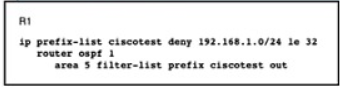
Refer to the exhibit.An engineer applied the configuration on R1 to prevent network 192.168.1.0/24 from being propagated outside of area 5. After the change, users have reported they are not able to access any of the application servers that were working before. While checking the routing table of the peer router. The engineer notices R1 stopped propagating any routes outside are 5. Which action must be taken to fix the problem?
D) Add a permit statement for 0.0.0.0/0 le 32 to the end of the prefix-list 10 override the implicit deny.
A) Configure an additional filter-list on R1 for inbound traffic to allow external router into area 5.
B) Reconfigure the filter-list statement to apply in the inbound direction
C) Change the prefix-list action to permit and add an explicit deny statement for network 192.168.1.0/24

Cisco 300-510 Exam - Topic 6 Question 123 Discussion

Actual exam question for Cisco's 300-510 exam
Question #: 123
Topic #: 6
[All 300-510 Questions]

Refer to the exhibit.

An engineer applied the configuration on R1 to prevent network 192.168.1.0/24 from being propagated outside of area 5. After the change, users have reported they are not able to access any of the application servers that were working before. While checking the routing table of the peer router. The engineer notices R1 stopped propagating any routes outside are 5. Which action must be taken to fix the problem?

Show Suggested Answer Hide Answer
Suggested Answer: D

Contribute your Thoughts:

0/2000 characters
Pearly
3 days ago
That’s a good point. We need to balance security and functionality.
upvoted 0 times
...
Kelvin
8 days ago
Maybe a combination of B and D? That could cover both bases.
upvoted 0 times
...
Caprice
13 days ago
Right, but if we don’t fix the inbound filter, users will still be blocked.
upvoted 0 times
...
Edda
19 days ago
True, but we need to allow necessary routes. B seems safer though.
upvoted 0 times
...
Pearly
24 days ago
I’m not sure about D. What if it opens up too much traffic?
upvoted 0 times
...
Kelvin
29 days ago
I’m leaning towards option D. Adding a permit statement could solve the access problem.
upvoted 0 times
...
Caprice
1 month ago
Agreed! I think option B makes sense. It addresses the inbound direction issue.
upvoted 0 times
...
Edda
1 month ago
This question is tricky. I feel like it's testing our understanding of routing filters.
upvoted 0 times
...
Valentin
1 month ago
Just to clarify, the filter-list was blocking everything, right?
upvoted 0 times
...
Vesta
2 months ago
Option D could also work, but it feels a bit risky.
upvoted 0 times
...
Deeanna
2 months ago
Wait, why would we need to allow external routers into area 5?
upvoted 0 times
...
Jeanice
2 months ago
Totally agree, B is the way to go!
upvoted 0 times
...
Tamala
2 months ago
I think option B makes the most sense here.
upvoted 0 times
...
Thea
2 months ago
I think we learned that explicit deny statements can help clarify routing issues. Maybe option C could be a solution, but I'm not entirely confident.
upvoted 0 times
...
Caprice
4 months ago
I feel like I might have mixed up the direction of the filter-list. Was it supposed to be inbound or outbound? I can't recall clearly.
upvoted 0 times
...
Latosha
4 months ago
This question seems similar to the practice questions where we had to adjust prefix-lists. I think option D might be the right choice to allow all traffic.
upvoted 0 times
...
Joanna
4 months ago
I remember we discussed filter-lists in class, but I'm not sure if I should be looking at inbound or outbound configurations here.
upvoted 0 times
...

Save Cancel