- Free Preparation Discussions
 MENU
MENU
Free CIPS L6M1 Exam Dumps October 2026
Here you can find all the free questions related with CIPS Strategic Ethical Leadership (L6M1) exam. You can also find on this page links to recently updated premium files with which you can practice for actual CIPS Strategic Ethical Leadership Exam. These premium versions are provided as L6M1 exam practice tests, both as desktop software and browser based application, you can use whatever suits your style. Feel free to try the Strategic Ethical Leadership Exam premium files for free, Good luck with your CIPS Strategic Ethical Leadership Exam.MultipleChoice
SIMULATION
Discuss the following strategies for resolving conflict: prevention, conflict management and conflict resolution. Provide examples of where these strategies may be appropriate, giving advantages and disadvantages to each (25 points)
OptionsAExplanation
Overall explanation
Below you will find how you can plan and draft the essay. Remember this is an example of one way you could approach the question. At Level 6 the questions are much more open so your response may be completely different and that's okay.
Essay plan
Intro -- conflict is part of human nature
P1 -- prevention, example, advantages, disadvantages
P2 -- conflict management, example, advantages, disadvantages
P3 -- conflict resolution, example, advantages, disadvantages
Conclusion -- which one depends on people involved, nature of conflict and severity.
Example Essay
Conflict is a natural part of human interaction and can occur in various contexts, including personal relationships, workplaces, and communities. To address conflicts in the workplace effectively, organizations often employ three primary strategies: prevention, conflict management, and conflict resolution. Each strategy has its advantages and disadvantages, and their appropriateness depends on the specific situation and the parties involved.
Conflict Prevention: Conflict prevention involves proactively identifying potential sources of conflict and taking measures to prevent them from escalating into disputes. For example an organization implements clear communication channels and policies to address employee grievances promptly, reducing the likelihood of conflicts stemming from miscommunication. Another example may be a line manager and new employee discussing their expectations and boundaries early in their relationship to avoid misunderstandings that could lead to conflicts later.
Advantages:
- Cost-effective: Preventing conflicts is often more cost-effective than dealing with their consequences.
- Preserves relationships: It helps maintain positive relationships by avoiding unnecessary tension and hostility.
- Promotes productivity: In a workplace, conflict prevention can lead to a more harmonious and productive environment. People feel more comfortable and less stressed when they know where they stand.
Disadvantages:
- Not always possible: Some conflicts are inevitable, and prevention may not address deeply rooted issues. It's also not possible to predict every conflict. Prevention only works if you foresee issues.
- Time-consuming: Implementing preventive measures can require time and effort. Especially if it's not known whether a conflict will arise or not.
Conflict Management: Conflict management focuses on addressing conflicts as they arise, with the aim of minimizing their negative effects and finding mutually acceptable solutions. People openly discuss the conflict with the aim of reaching a mutual understanding of the disagreement. This approach requires a supportive leader trained in group skills and is usually used to try and prevent, or at least minimise, conflicts as they arise. For example, in a workplace two colleagues disagree about the best way to approach a task -- they take the discussion to a meeting room with their supervisor and reach an agreeable outcome by finding common ground such as splitting the task into two parts, and each taking responsibility for their part.
Advantages:
- Addresses issues directly: Conflict management acknowledges the problem and attempts to find solutions.
- Preserves relationships: When managed well, conflicts can strengthen relationships by fostering understanding and compromise.
- Opportunity for growth: It can lead to personal and organizational growth by addressing underlying issues.
Disadvantages:
- Time and energy-consuming: Conflict management can be emotionally draining and time-consuming.
- Risk of escalation: If not handled properly, conflicts can escalate and get worse, causing more harm in the long term.
- No guarantee of resolution: Some conflicts may not have easily achievable solutions.
Conflict Resolution. Conflict resolution is the process of finding a definitive solution to a conflict, often resulting in a formal agreement that satisfies all parties. It is used after conflict has already broken out and sometimes when conflict management has already failed. A 3rd party such as a Liaison Officer mediates a resolution meeting, setting rules and procedures on behaviour conduct. An example of this is a dispute between buyer and supplier over a contract term which is taken to alternative dispute resolution such as arbitration. Another example may be a dispute between two employees which is taken to HR and each employee has a representative/ witness present.
Advantages:
- Permanent solution: Conflict resolution aims to resolve the issue once and for all. Unlike the other two approaches, the decision is final and cannot be undone.
- Legal and formal: It can be legally binding and provide a clear framework for compliance, unlike the other two options.
Disadvantages:
- Time-consuming: Conflict resolution can take a significant amount of time, especially if legal proceedings are involved.
- Costly: It can be expensive, particularly when legal or professional mediation services are required such as contract disputes between buyers and sellers.
- May not satisfy all parties: Some parties may feel they've lost or been unfairly treated, which can lead to lingering resentment.
In practice, the choice of strategy depends on the nature and severity of the conflict, the parties involved, and the desired outcomes. Often, a combination of these strategies may be employed to effectively address conflicts in various situations. Effective conflict management requires adaptability and a careful assessment of the specific circumstances to determine the most appropriate approach.
Tutor Notes
- there are so many parts to this question. I recommend doing a quick plan at the start like I've done. You can then flick back to this once you've finished your essay to check you've included all the points. For example, did you write the disadvantage of conflict management? Did you include an example of conflict resolution? There's so many things you could accidentally miss out here so do double check your work at the end.
- Students often get conflict management and conflict resolution mixed-up. Hopefully the above essay helps clear this up if you weren't sure before.
- Some quotes on conflict management which you could use in your essay:
'In the middle of every difficulty lies opportunity.' --- Albert Einstein
'If you want to resolve a conflict, you must be willing to compromise.' --- John Hume
- Study guide p. 254
MultipleChoice
SIMULATION
Discuss the following strategies for resolving conflict: prevention, conflict management and conflict resolution. Provide examples of where these strategies may be appropriate, giving advantages and disadvantages to each (25 points)
OptionsAExplanation
Overall explanation
Below you will find how you can plan and draft the essay. Remember this is an example of one way you could approach the question. At Level 6 the questions are much more open so your response may be completely different and that's okay.
Essay plan
Intro -- conflict is part of human nature
P1 -- prevention, example, advantages, disadvantages
P2 -- conflict management, example, advantages, disadvantages
P3 -- conflict resolution, example, advantages, disadvantages
Conclusion -- which one depends on people involved, nature of conflict and severity.
Example Essay
Conflict is a natural part of human interaction and can occur in various contexts, including personal relationships, workplaces, and communities. To address conflicts in the workplace effectively, organizations often employ three primary strategies: prevention, conflict management, and conflict resolution. Each strategy has its advantages and disadvantages, and their appropriateness depends on the specific situation and the parties involved.
Conflict Prevention: Conflict prevention involves proactively identifying potential sources of conflict and taking measures to prevent them from escalating into disputes. For example an organization implements clear communication channels and policies to address employee grievances promptly, reducing the likelihood of conflicts stemming from miscommunication. Another example may be a line manager and new employee discussing their expectations and boundaries early in their relationship to avoid misunderstandings that could lead to conflicts later.
Advantages:
- Cost-effective: Preventing conflicts is often more cost-effective than dealing with their consequences.
- Preserves relationships: It helps maintain positive relationships by avoiding unnecessary tension and hostility.
- Promotes productivity: In a workplace, conflict prevention can lead to a more harmonious and productive environment. People feel more comfortable and less stressed when they know where they stand.
Disadvantages:
- Not always possible: Some conflicts are inevitable, and prevention may not address deeply rooted issues. It's also not possible to predict every conflict. Prevention only works if you foresee issues.
- Time-consuming: Implementing preventive measures can require time and effort. Especially if it's not known whether a conflict will arise or not.
Conflict Management: Conflict management focuses on addressing conflicts as they arise, with the aim of minimizing their negative effects and finding mutually acceptable solutions. People openly discuss the conflict with the aim of reaching a mutual understanding of the disagreement. This approach requires a supportive leader trained in group skills and is usually used to try and prevent, or at least minimise, conflicts as they arise. For example, in a workplace two colleagues disagree about the best way to approach a task -- they take the discussion to a meeting room with their supervisor and reach an agreeable outcome by finding common ground such as splitting the task into two parts, and each taking responsibility for their part.
Advantages:
- Addresses issues directly: Conflict management acknowledges the problem and attempts to find solutions.
- Preserves relationships: When managed well, conflicts can strengthen relationships by fostering understanding and compromise.
- Opportunity for growth: It can lead to personal and organizational growth by addressing underlying issues.
Disadvantages:
- Time and energy-consuming: Conflict management can be emotionally draining and time-consuming.
- Risk of escalation: If not handled properly, conflicts can escalate and get worse, causing more harm in the long term.
- No guarantee of resolution: Some conflicts may not have easily achievable solutions.
Conflict Resolution. Conflict resolution is the process of finding a definitive solution to a conflict, often resulting in a formal agreement that satisfies all parties. It is used after conflict has already broken out and sometimes when conflict management has already failed. A 3rd party such as a Liaison Officer mediates a resolution meeting, setting rules and procedures on behaviour conduct. An example of this is a dispute between buyer and supplier over a contract term which is taken to alternative dispute resolution such as arbitration. Another example may be a dispute between two employees which is taken to HR and each employee has a representative/ witness present.
Advantages:
- Permanent solution: Conflict resolution aims to resolve the issue once and for all. Unlike the other two approaches, the decision is final and cannot be undone.
- Legal and formal: It can be legally binding and provide a clear framework for compliance, unlike the other two options.
Disadvantages:
- Time-consuming: Conflict resolution can take a significant amount of time, especially if legal proceedings are involved.
- Costly: It can be expensive, particularly when legal or professional mediation services are required such as contract disputes between buyers and sellers.
- May not satisfy all parties: Some parties may feel they've lost or been unfairly treated, which can lead to lingering resentment.
In practice, the choice of strategy depends on the nature and severity of the conflict, the parties involved, and the desired outcomes. Often, a combination of these strategies may be employed to effectively address conflicts in various situations. Effective conflict management requires adaptability and a careful assessment of the specific circumstances to determine the most appropriate approach.
Tutor Notes
- there are so many parts to this question. I recommend doing a quick plan at the start like I've done. You can then flick back to this once you've finished your essay to check you've included all the points. For example, did you write the disadvantage of conflict management? Did you include an example of conflict resolution? There's so many things you could accidentally miss out here so do double check your work at the end.
- Students often get conflict management and conflict resolution mixed-up. Hopefully the above essay helps clear this up if you weren't sure before.
- Some quotes on conflict management which you could use in your essay:
'In the middle of every difficulty lies opportunity.' --- Albert Einstein
'If you want to resolve a conflict, you must be willing to compromise.' --- John Hume
- Study guide p. 254
MultipleChoice
SIMULATION
Discuss 5 different sources of power an individual can have in the working environment. Explain who in an organisation may have this type of power and the pros and cons to each (25 points)
OptionsAExplanation
Sources of Power in the Workplace: Types, Organizational Roles, and Their Pros & Cons
Power in the workplace influences decision-making, leadership effectiveness, and team dynamics. French and Raven's five sources of power---legitimate, reward, coercive, expert, and referent power---are commonly found in organizational settings. Each type of power has advantages and disadvantages, depending on how it is used. This essay explores these five sources of power, their typical holders within an organization, and their pros and cons.
1. Legitimate Power
Definition:
Legitimate power is derived from a formal position or authority within an organization. It comes from the structure of the company rather than an individual's personal qualities.
Who Holds This Power?
CEOs, Directors, Managers, Supervisors, Team Leaders
Example: A Procurement Director has legitimate power to approve supplier contracts.
Pros:
Provides clear authority and structure in decision-making.
Helps maintain order and accountability in an organization.
Employees respect and follow official leaders.
Cons:
Can lead to resistance if employees feel decisions are made without consultation.
Overuse of authority can create a rigid, bureaucratic environment.
Power is temporary---losing the title means losing authority.
2. Reward Power
Definition:
Reward power is the ability to influence behavior by offering incentives such as bonuses, promotions, pay raises, or recognition.
Who Holds This Power?
HR Managers, CEOs, Procurement Heads, Line Managers
Example: A Procurement Manager offers performance bonuses to encourage supplier cost reductions.
Pros:
Motivates employees to achieve goals.
Encourages high performance and engagement.
Helps reinforce positive behaviors in the workplace.
Cons:
Can create entitlement issues---employees may expect rewards for all tasks.
If rewards are inconsistent, it can lead to demotivation.
Over-reliance on rewards may reduce intrinsic motivation (employees only work for rewards, not passion).
3. Coercive Power
Definition:
Coercive power comes from the ability to punish or enforce negative consequences for poor performance, non-compliance, or misconduct.
Who Holds This Power?
Supervisors, Compliance Officers, HR Managers, Security Heads
Example: A Chief Compliance Officer enforces penalties for unethical procurement practices.
Pros:
Ensures discipline and adherence to company policies.
Helps prevent unethical behavior (e.g., fraud in procurement).
Encourages employees to meet deadlines and expectations.
Cons:
Creates fear and resentment among employees.
Can lead to low morale and high turnover.
Not effective long-term---employees may comply out of fear, not respect.
4. Expert Power
Definition:
Expert power comes from specialized knowledge, skills, or expertise that make an individual valuable in the workplace.
Who Holds This Power?
Subject Matter Experts (SMEs), Senior Engineers, IT Specialists, Procurement Analysts
Example: A Procurement Data Analyst has expert power by using big data analytics to improve supply chain efficiency.
Pros:
Encourages trust and credibility among employees.
Expertise is highly valuable---companies rely on knowledgeable individuals.
Individuals with expert power often gain influence without formal authority.
Cons:
Power is limited to specific expertise---not useful outside their domain.
If not shared, expertise can lead to knowledge hoarding (lack of collaboration).
Overconfidence in expertise can make individuals resistant to learning new approaches.
5. Referent Power
Definition:
Referent power is based on charisma, respect, and personal influence rather than authority or knowledge.
Who Holds This Power?
Charismatic Leaders, Mentors, Senior Employees with Strong Relationships
Example: A Senior Procurement Executive with strong leadership qualities inspires the team to embrace change.
Pros:
Creates loyalty and trust among employees.
Can be used to influence without authority.
Helps in mentoring and developing future leaders.
Cons:
Can be subjective---depends on personality and relationships.
Overuse can lead to favoritism and bias in decision-making.
Can be ineffective if employees do not personally respect the leader.
Conclusion
In any workplace, different individuals hold different types of power based on their role, expertise, and relationships. While legitimate, reward, coercive, expert, and referent power all contribute to leadership and decision-making, each has its own advantages and drawbacks. Effective leaders and procurement professionals must balance these power sources strategically, ensuring that authority is respected, motivation is sustained, discipline is enforced fairly, expertise is valued, and personal influence is used ethically.
MultipleChoice
SIMULATION
Evaluate the following approaches to leadership: autocratic and affiliative (25 points)
OptionsAExplanation
Evaluation of Autocratic and Affiliative Leadership Approaches (25 Points)
Leadership approaches vary based on organizational needs, culture, and objectives. Below is an in-depth evaluation of Autocratic Leadership and Affiliative Leadership, focusing on their characteristics, advantages, disadvantages, and suitability in procurement and supply chain management.
1. Autocratic Leadership (12.5 Points)
Definition and Characteristics
Autocratic leadership is a command-and-control approach where decision-making is centralized, and the leader exerts full authority over subordinates. Employees have little to no input in decisions.
Key Features:
The leader makes all critical decisions without consulting the team.
Strict top-down communication is followed.
Highly structured and rule-based management.
Focus on efficiency, discipline, and control.
Suitable for crisis management, military organizations, and high-risk industries.
Advantages of Autocratic Leadership
Quick Decision-Making:
Since decisions are made by one leader, the process is fast and efficient, especially in time-sensitive situations such as supply chain disruptions.
Clear Chain of Command:
Employees have a clear understanding of who is in charge, reducing confusion and ensuring a structured workflow.
Improved Accountability:
With strict supervision, employees remain focused on their tasks, leading to higher productivity.
Effective in Crisis Situations:
In procurement, during a supply chain disruption (e.g., a supplier bankruptcy), a leader must make immediate decisions to secure alternative suppliers.
Disadvantages of Autocratic Leadership
Lack of Employee Engagement & Motivation:
Since employees have no voice in decision-making, they may feel undervalued, leading to low morale and high turnover.
Reduced Innovation & Creativity:
Employees are not encouraged to share new ideas or problem-solving approaches, which can limit procurement process improvements.
Potential for Micromanagement:
Autocratic leaders tend to oversee every detail, leading to inefficiency and lack of trust in the team.
Suitability in Procurement & Supply Chain
Best suited for highly regulated industries (e.g., government procurement, defense supply chains).
Effective in emergency situations (e.g., supplier failure, legal compliance issues).
Not ideal for collaborative procurement environments where supplier relationships and teamwork are crucial.
2. Affiliative Leadership (12.5 Points)
Definition and Characteristics
Affiliative leadership is a people-first leadership style that prioritizes employee well-being, relationships, and harmony within teams.
Key Features:
Focus on empathy and emotional intelligence.
The leader builds strong team bonds and fosters a positive workplace culture.
Employees are encouraged to collaborate and voice their opinions.
Suitable for organizations undergoing change, stress, or morale issues.
Advantages of Affiliative Leadership
Boosts Employee Morale and Motivation:
Employees feel valued and supported, leading to higher job satisfaction and retention.
Encourages Collaboration and Innovation:
Unlike autocratic leadership, an affiliative leader welcomes team input, encouraging creative solutions in procurement strategies.
Strengthens Supplier Relationships:
In procurement, affiliative leadership improves negotiations and long-term supplier partnerships through trust and open communication.
Effective During Organizational Change:
This approach helps teams adapt to new procurement strategies, digital transformations, or policy changes smoothly.
Disadvantages of Affiliative Leadership
Lack of Firm Decision-Making:
Leaders may avoid conflict or tough decisions to maintain team harmony, leading to slow decision-making.
Risk of Lower Performance Expectations:
Overemphasizing relationships may reduce accountability, leading to underperformance in procurement teams.
Not Suitable for Crisis Management:
In urgent procurement situations (e.g., contract disputes, legal violations), an affiliative leader may struggle to enforce discipline.
Suitability in Procurement & Supply Chain
Best for relationship-driven roles (e.g., supplier relationship management, collaborative procurement).
Effective in team-building and change management (e.g., transitioning to digital procurement systems).
Not ideal for high-risk decision-making environments (e.g., crisis procurement, compliance enforcement).
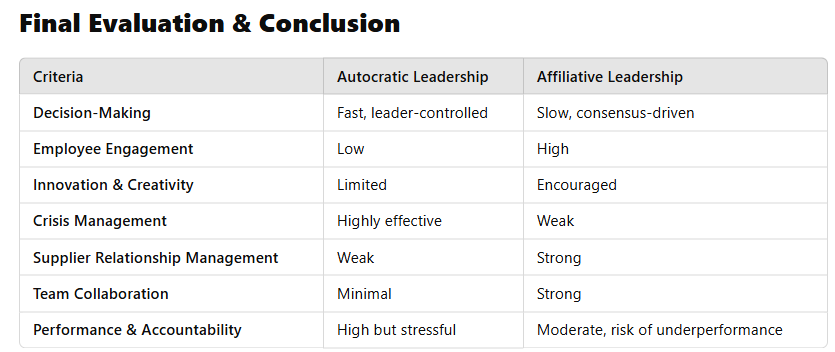
Which Leadership Style is Best for Procurement?
For short-term crises, regulatory compliance, or high-risk procurement Autocratic Leadership is better.
For long-term supplier management, teamwork, and innovation Affiliative Leadership is more effective.
A balanced approach (situational leadership) that combines elements of both styles is often the most effective strategy in procurement.
This evaluation provides a structured, detailed comparison that aligns with CIPS L6M1 exam expectations.
MultipleChoice
SIMULATION
Michael is the new CEO of XYZ Ltd. He has recently joined the organisation which has been struggling financially and has issues with stakeholder communication. He is considering using the Democratic leadership approach. What are the advantages and disadvantages of this approach? Is this an appropriate style for Michael to adopt? (25 points)
OptionsAExplanation
Introduction
Leadership plays a crucial role in the success of an organization, especially when it is facing financial difficulties and stakeholder communication issues. The choice of leadership style significantly impacts employee morale, decision-making efficiency, and overall business performance. Michael, the new CEO of XYZ Ltd., is considering adopting the Democratic Leadership Approach to address these challenges.
This essay will examine the advantages and disadvantages of the Democratic Leadership Style and assess whether it is an appropriate leadership approach for Michael given the company's current challenges.
Understanding Democratic Leadership
Democratic leadership, also known as participative leadership, is a leadership style in which decision-making is shared between the leader and their team members. It encourages collaboration, open communication, and employee engagement, ensuring that various perspectives are considered before making strategic decisions.
Key Characteristics of Democratic Leadership
Inclusive Decision-Making -- Employees and stakeholders are actively involved in decision-making.
Encourages Open Communication -- The leader fosters a transparent and open communication culture.
Focus on Teamwork and Collaboration -- Employees work together towards shared goals.
Emphasis on Employee Empowerment -- Employees feel valued and are encouraged to contribute ideas.
Long-Term Strategic Thinking -- Decisions are made collectively, considering long-term benefits.
Advantages of Democratic Leadership (10 Points)
1. Improved Employee Engagement and Morale
Employees feel valued and respected because they are included in decision-making processes.
This leads to higher motivation, job satisfaction, and productivity.
Example: In procurement, involving team members in supplier selection ensures better buy-in and accountability.
2. Better Decision-Making Through Diverse Perspectives
Employees at different levels of the organization contribute unique insights.
Encouraging open discussions can lead to better problem-solving and innovation.
Example: Engaging employees in financial turnaround strategies might lead to cost-saving ideas from the procurement or finance teams.
3. Strengthens Stakeholder Relationships and Communication
Democratic leadership improves communication with both internal stakeholders (employees, managers) and external stakeholders (investors, suppliers, customers).
By involving stakeholders in discussions, trust and cooperation are enhanced.
Example: Regular stakeholder meetings and open discussions on financial recovery plans can reduce uncertainty and resistance.
4. Encourages Creativity and Innovation
Employees are given the freedom to propose new ideas, leading to continuous improvement.
Example: In procurement, an inclusive approach might encourage supply chain digitalization or sustainable procurement strategies.
5. Builds a Positive Organizational Culture
A democratic leader promotes transparency, fairness, and ethical leadership.
This leads to a more positive work environment, reducing employee turnover.
Disadvantages of Democratic Leadership (10 Points)
1. Slow Decision-Making Process
Since multiple people are involved in decision-making, it takes longer to reach a consensus.
This can be problematic when quick decisions are required, especially in financial crisis situations.
Example: If XYZ Ltd. needs to immediately cut costs, too much discussion may delay urgent cost-saving measures.
2. Risk of Conflict and Disagreements
Open discussions may lead to conflicting opinions, making it difficult to find a common ground.
This can create delays and inefficiencies in procurement and financial strategies.
Example: If procurement and finance teams disagree on cost-cutting strategies, decision-making could be stalled.
3. Requires Skilled and Experienced Employees
Democratic leadership works best when employees are experienced, knowledgeable, and capable of making informed decisions.
If employees lack expertise, their contributions may lead to poor strategic choices.
Example: A procurement team without risk management experience might suggest suppliers without considering geopolitical risks.
4. Ineffective in Crisis Situations
In urgent situations where immediate action is required, democratic leadership may not be effective.
Leaders might need to make quick, authoritative decisions to stabilize the business.
Example: If XYZ Ltd. is on the verge of bankruptcy, Michael may need to quickly implement cost-cutting measures without waiting for employee consensus.
5. Potential for a Lack of Accountability
When decisions are made collectively, it may be unclear who is responsible for failures.
Employees may avoid taking responsibility, assuming others will handle problems.
Example: If a supplier selection decision fails, no single person may be held accountable.
Is Democratic Leadership Appropriate for Michael at XYZ Ltd.? (5 Points)
Given the challenges at XYZ Ltd. (financial struggles and stakeholder communication issues), democratic leadership has both advantages and risks. Below is an assessment of whether this style is suitable for Michael:
Reasons Why Democratic Leadership is Suitable:
Improves stakeholder communication -- Since XYZ Ltd. struggles with stakeholder relations, a democratic approach can help build trust and collaboration.
Boosts employee morale -- Employees in a struggling company may feel demotivated. Involving them in decision-making increases engagement and motivation.
Encourages innovative solutions -- XYZ Ltd. may need creative financial recovery strategies, and a democratic approach could generate new cost-saving ideas.
Reasons Why Democratic Leadership May Not Be Ideal:
Slow decision-making -- XYZ Ltd. needs quick financial recovery decisions, which democratic leadership may delay.
May cause internal conflicts -- If stakeholders have conflicting ideas on financial strategies, it may slow down progress.
Not effective in crisis management -- Michael may need to make tough cost-cutting decisions quickly, which requires a more authoritative approach.
Recommended Approach for Michael:
Instead of adopting a purely democratic leadership style, Michael should consider a balanced approach:
Use democratic leadership for long-term strategic planning -- Engage employees and stakeholders when designing long-term recovery strategies.
Adopt an authoritative approach for urgent financial decisions -- If immediate cost-cutting or restructuring is needed, Michael should make firm, quick decisions.
Communicate decisions transparently -- Even when making executive decisions, Michael should keep employees and stakeholders informed to maintain trust.
This blended leadership style (situational leadership) allows Michael to benefit from democratic leadership's advantages while ensuring quick decision-making when necessary.
Conclusion
Democratic leadership has several advantages, including improving communication, employee morale, and stakeholder relationships, all of which are beneficial for XYZ Ltd. However, it also slows decision-making and may cause conflicts, which can be problematic given the company's financial struggles.
Michael should adopt a situational leadership approach, combining democratic leadership for long-term strategic planning with authoritative leadership for urgent financial decisions. This will ensure that XYZ Ltd. recovers financially while maintaining transparency and employee engagement.
By balancing these approaches, Michael can lead XYZ Ltd. out of financial struggles while fostering a positive organizational culture.
Final Answer Structure for Maximum Marks (25 Points)
Introduction (3 Points) -- Overview of the problem and introduction to democratic leadership.
Key Characteristics of Democratic Leadership (4 Points) -- Explanation of democratic leadership style.
Advantages of Democratic Leadership (10 Points) -- Five advantages with explanations and examples.
Disadvantages of Democratic Leadership (10 Points) -- Five disadvantages with explanations and examples.
Suitability for Michael (5 Points) -- Balanced evaluation of whether this leadership style is appropriate.
Conclusion (3 Points) -- Summary and recommendation of situational leadership approach.
MultipleChoice
SIMULATION
Explain, with examples, how a Procurement Professional can apply the CIPS Code of Conduct in relation to ethical business practices (25 points).
OptionsAExplanation
Overall explanation
Below you will find how you can plan and draft the essay. Remember this is an example of one way you could approach the question. At Level 6 the questions are much more open so your response may be completely different and that's okay.
Essay Plan
Introduction -- what is it?
Paragraph 1 -- standing
Paragraph 2- integrity
Paragraph 3 -- promote
Paragraph 4 -- proficiency
paragraph 5 -- regulations
Conclusion -- it's super important
Example Essay
The CIPS (Chartered Institute of Procurement & Supply) Code of Conduct serves as a guiding framework for procurement and supply chain professionals to maintain ethical standards and professional integrity in their work. This essay will explore how procurement professionals can apply various aspects of the CIPS Code of Conduct to ensure ethical business practices. It will address each of the five core principles outlined in the Code of Conduct: Standing, Integrity, Promotion, Proficiency, and Regulations, providing relevant examples for each.
Standing:
One of the key principles of the CIPS Code of Conduct is to enhance and protect the standing of the profession. Procurement professionals can apply this by avoiding conduct that would bring the profession or CIPS into disrepute. For example, if a procurement manager discovers evidence of bid rigging among potential suppliers, adhering to this principle would involve promptly reporting the suspicious activity to their organization's compliance department. By doing so, they not only uphold professional standards, but also safeguard the organization's reputation.
Integrity:
Maintaining personal and professional integrity is fundamental to ethical business practices. The Code of Conduct emphasizes that procurement professionals should never engage in conduct, either professional or personal, that would bring the profession or CIPS into disrepute. For instance, if a supply chain manager is offered an extravagant gift by a vendor during negotiations, they should decline the gift and report the offer to their supervisor or compliance department. This action upholds personal and professional integrity, ensuring impartiality in supplier selection.
Promotion:
Procurement professionals can actively promote ethical practices within their organizations and supply chains, aligning with the Code of Conduct. For example, they can advocate for sustainable and ethical sourcing practices. If a procurement manager selects suppliers who adhere to fair labour standards and environmentally responsible practices, they set an example that encourages others to prioritize ethical practices. By actively promoting these principles, they contribute to a culture of integrity and social responsibility.
Proficiency:
Enhancing and protecting the standing of the profession also involves a commitment to proficiency. Procurement professionals can apply this principle by continually developing and maintaining their professional skills and competencies. For instance, attending training programs and industry conferences regularly can help them stay updated on the latest ethical standards and best practices. Pursuing certifications related to ethical sourcing, such as sustainable supply chain management credentials, further demonstrates their commitment to proficiency.
Regulations:
The CIPS Code of Conduct underscores the importance of compliance with relevant laws and regulations in procurement and supply chain management. Procurement professionals should ensure that all sourcing activities align with legal requirements. For example, they can conduct due diligence to confirm that suppliers adhere to anti-corruption laws, trade restrictions, and environmental regulations. This not only minimizes legal and ethical risks but also ensures ethical conduct within the supply chain.
Conclusion:
In conclusion, procurement professionals play a crucial role in maintaining ethical business practices by applying the principles outlined in the CIPS Code of Conduct. By adhering to these principles related to Standing, Integrity, Promotion, Proficiency, and Regulations, they contribute to the ethical and responsible functioning of their organizations and the broader supply chain industry. Upholding ethical standards not only safeguards professional integrity but also fosters trust and transparency in procurement and supply chain management.
Tutor Notes
- The CIPS code of conduct has come up as a 25 point question in Level 4 and Level 5 exams, so there is no reason to believe it couldn't come up at Level 6. Nothing has changed in terms of content, but at this Level be prepared to give more examples of it being applied in practice.
- Another way this could be asked is in relation to a case study. E.g. Mark is a procurement professional and X and Y are going on at his organisation. Using the CIPS Code of Conduct, what should he do about X and Y?
MultipleChoice
SIMULATION
Explain and evaluate how a Leader can use Management by Objectives (10 points). Discuss THREE ways to measure the effectiveness of leadership (15 points)
OptionsAExplanation
Management by Objectives (MBO) and Measuring Leadership Effectiveness
Part 1: How a Leader Can Use Management by Objectives (MBO) (10 Points)
Definition of Management by Objectives (MBO)
Management by Objectives (MBO) is a leadership approach where leaders and employees set specific, measurable goals that align with the organization's strategic objectives. Developed by Peter Drucker, MBO emphasizes clear goal setting, performance tracking, and employee involvement.
How a Leader Can Use MBO Effectively
Setting Clear Objectives
Leaders work with employees to establish SMART goals (Specific, Measurable, Achievable, Relevant, Time-bound).
Example: A procurement leader may set an objective to reduce supplier costs by 10% within six months.
Aligning Individual and Organizational Goals
Ensures employees understand how their goals contribute to the company's success.
Example: A CPO (Chief Procurement Officer) aligns procurement cost-saving goals with the finance department's budget objectives.
Regular Performance Monitoring
Leaders conduct periodic reviews to track progress and provide feedback.
Example: Monthly progress check-ins ensure employees stay on track toward procurement efficiency goals.
Providing Support and Resources
Leaders remove obstacles and provide training or tools to help employees achieve their objectives.
Example: Implementing new procurement software to improve efficiency.
Performance Evaluation and Rewards
Employees are evaluated based on objective achievements, and success is rewarded (e.g., bonuses, promotions).
Example: Procurement staff meeting targets could receive performance-based incentives.
Evaluation of MBO's Effectiveness
Pros: Improves goal clarity, accountability, and motivation.
Cons: Can be rigid if objectives are too fixed, ignoring external changes.
Part 2: Three Ways to Measure Leadership Effectiveness (15 Points)
A leader's effectiveness is crucial for team performance, motivation, and achieving strategic objectives. Below are three key ways to measure leadership effectiveness.
1. Employee Engagement and Satisfaction
Definition: The level of motivation, commitment, and job satisfaction employees have under a leader.
How to Measure:
Conduct employee engagement surveys (e.g., using Likert scale questions).
Measure retention rates---low turnover indicates effective leadership.
Track employee feedback in performance reviews.
Why It's Important:
A highly engaged workforce is more productive and innovative.
Employees who trust leadership stay longer and contribute more.
2. Achievement of Organizational and Team Goals
Definition: The ability of a leader to drive the team toward achieving company objectives.
How to Measure:
Compare actual vs. target performance metrics (e.g., cost savings in procurement).
Analyze key performance indicators (KPIs) like project completion rates.
Track efficiency improvements in processes under the leader's direction.
Why It's Important:
Demonstrates how well a leader can set, communicate, and execute strategic goals.
Ensures leadership is focused on tangible results, not just employee relationships.
3. Adaptability and Problem-Solving Ability
Definition: A leader's ability to navigate challenges, handle change, and innovate under pressure.
How to Measure:
Assess how a leader handles crises or disruptions (e.g., supply chain breakdowns).
Review decision-making effectiveness during uncertain situations.
Gather 360-degree feedback from peers, subordinates, and senior leaders.
Why It's Important:
Business environments change---leaders must adapt quickly to remain effective.
Ensures that leadership is proactive rather than reactive in problem-solving.
Conclusion
A leader can use Management by Objectives (MBO) to drive performance through goal-setting, alignment, monitoring, and evaluation. Leadership effectiveness can be measured through employee engagement, goal achievement, and adaptability, ensuring that leaders not only set objectives but also inspire teams, navigate challenges, and deliver measurable success.
MultipleChoice
SIMULATION
Discuss the following strategies for resolving conflict: prevention, conflict management and conflict resolution. Provide examples of where these strategies may be appropriate, giving advantages and disadvantages to each (25 points)
OptionsAExplanation
Overall explanation
Below you will find how you can plan and draft the essay. Remember this is an example of one way you could approach the question. At Level 6 the questions are much more open so your response may be completely different and that's okay.
Essay plan
Intro -- conflict is part of human nature
P1 -- prevention, example, advantages, disadvantages
P2 -- conflict management, example, advantages, disadvantages
P3 -- conflict resolution, example, advantages, disadvantages
Conclusion -- which one depends on people involved, nature of conflict and severity.
Example Essay
Conflict is a natural part of human interaction and can occur in various contexts, including personal relationships, workplaces, and communities. To address conflicts in the workplace effectively, organizations often employ three primary strategies: prevention, conflict management, and conflict resolution. Each strategy has its advantages and disadvantages, and their appropriateness depends on the specific situation and the parties involved.
Conflict Prevention: Conflict prevention involves proactively identifying potential sources of conflict and taking measures to prevent them from escalating into disputes. For example an organization implements clear communication channels and policies to address employee grievances promptly, reducing the likelihood of conflicts stemming from miscommunication. Another example may be a line manager and new employee discussing their expectations and boundaries early in their relationship to avoid misunderstandings that could lead to conflicts later.
Advantages:
- Cost-effective: Preventing conflicts is often more cost-effective than dealing with their consequences.
- Preserves relationships: It helps maintain positive relationships by avoiding unnecessary tension and hostility.
- Promotes productivity: In a workplace, conflict prevention can lead to a more harmonious and productive environment. People feel more comfortable and less stressed when they know where they stand.
Disadvantages:
- Not always possible: Some conflicts are inevitable, and prevention may not address deeply rooted issues. It's also not possible to predict every conflict. Prevention only works if you foresee issues.
- Time-consuming: Implementing preventive measures can require time and effort. Especially if it's not known whether a conflict will arise or not.
Conflict Management: Conflict management focuses on addressing conflicts as they arise, with the aim of minimizing their negative effects and finding mutually acceptable solutions. People openly discuss the conflict with the aim of reaching a mutual understanding of the disagreement. This approach requires a supportive leader trained in group skills and is usually used to try and prevent, or at least minimise, conflicts as they arise. For example, in a workplace two colleagues disagree about the best way to approach a task -- they take the discussion to a meeting room with their supervisor and reach an agreeable outcome by finding common ground such as splitting the task into two parts, and each taking responsibility for their part.
Advantages:
- Addresses issues directly: Conflict management acknowledges the problem and attempts to find solutions.
- Preserves relationships: When managed well, conflicts can strengthen relationships by fostering understanding and compromise.
- Opportunity for growth: It can lead to personal and organizational growth by addressing underlying issues.
Disadvantages:
- Time and energy-consuming: Conflict management can be emotionally draining and time-consuming.
- Risk of escalation: If not handled properly, conflicts can escalate and get worse, causing more harm in the long term.
- No guarantee of resolution: Some conflicts may not have easily achievable solutions.
Conflict Resolution. Conflict resolution is the process of finding a definitive solution to a conflict, often resulting in a formal agreement that satisfies all parties. It is used after conflict has already broken out and sometimes when conflict management has already failed. A 3rd party such as a Liaison Officer mediates a resolution meeting, setting rules and procedures on behaviour conduct. An example of this is a dispute between buyer and supplier over a contract term which is taken to alternative dispute resolution such as arbitration. Another example may be a dispute between two employees which is taken to HR and each employee has a representative/ witness present.
Advantages:
- Permanent solution: Conflict resolution aims to resolve the issue once and for all. Unlike the other two approaches, the decision is final and cannot be undone.
- Legal and formal: It can be legally binding and provide a clear framework for compliance, unlike the other two options.
Disadvantages:
- Time-consuming: Conflict resolution can take a significant amount of time, especially if legal proceedings are involved.
- Costly: It can be expensive, particularly when legal or professional mediation services are required such as contract disputes between buyers and sellers.
- May not satisfy all parties: Some parties may feel they've lost or been unfairly treated, which can lead to lingering resentment.
In practice, the choice of strategy depends on the nature and severity of the conflict, the parties involved, and the desired outcomes. Often, a combination of these strategies may be employed to effectively address conflicts in various situations. Effective conflict management requires adaptability and a careful assessment of the specific circumstances to determine the most appropriate approach.
Tutor Notes
- there are so many parts to this question. I recommend doing a quick plan at the start like I've done. You can then flick back to this once you've finished your essay to check you've included all the points. For example, did you write the disadvantage of conflict management? Did you include an example of conflict resolution? There's so many things you could accidentally miss out here so do double check your work at the end.
- Students often get conflict management and conflict resolution mixed-up. Hopefully the above essay helps clear this up if you weren't sure before.
- Some quotes on conflict management which you could use in your essay:
'In the middle of every difficulty lies opportunity.' --- Albert Einstein
'If you want to resolve a conflict, you must be willing to compromise.' --- John Hume
- Study guide p. 254
MultipleChoice
SIMULATION
Discuss 5 different sources of power an individual can have in the working environment. Explain who in an organisation may have this type of power and the pros and cons to each (25 points)
OptionsAExplanation
Sources of Power in the Workplace: Types, Organizational Roles, and Their Pros & Cons
Power in the workplace influences decision-making, leadership effectiveness, and team dynamics. French and Raven's five sources of power---legitimate, reward, coercive, expert, and referent power---are commonly found in organizational settings. Each type of power has advantages and disadvantages, depending on how it is used. This essay explores these five sources of power, their typical holders within an organization, and their pros and cons.
1. Legitimate Power
Definition:
Legitimate power is derived from a formal position or authority within an organization. It comes from the structure of the company rather than an individual's personal qualities.
Who Holds This Power?
CEOs, Directors, Managers, Supervisors, Team Leaders
Example: A Procurement Director has legitimate power to approve supplier contracts.
Pros:
Provides clear authority and structure in decision-making.
Helps maintain order and accountability in an organization.
Employees respect and follow official leaders.
Cons:
Can lead to resistance if employees feel decisions are made without consultation.
Overuse of authority can create a rigid, bureaucratic environment.
Power is temporary---losing the title means losing authority.
2. Reward Power
Definition:
Reward power is the ability to influence behavior by offering incentives such as bonuses, promotions, pay raises, or recognition.
Who Holds This Power?
HR Managers, CEOs, Procurement Heads, Line Managers
Example: A Procurement Manager offers performance bonuses to encourage supplier cost reductions.
Pros:
Motivates employees to achieve goals.
Encourages high performance and engagement.
Helps reinforce positive behaviors in the workplace.
Cons:
Can create entitlement issues---employees may expect rewards for all tasks.
If rewards are inconsistent, it can lead to demotivation.
Over-reliance on rewards may reduce intrinsic motivation (employees only work for rewards, not passion).
3. Coercive Power
Definition:
Coercive power comes from the ability to punish or enforce negative consequences for poor performance, non-compliance, or misconduct.
Who Holds This Power?
Supervisors, Compliance Officers, HR Managers, Security Heads
Example: A Chief Compliance Officer enforces penalties for unethical procurement practices.
Pros:
Ensures discipline and adherence to company policies.
Helps prevent unethical behavior (e.g., fraud in procurement).
Encourages employees to meet deadlines and expectations.
Cons:
Creates fear and resentment among employees.
Can lead to low morale and high turnover.
Not effective long-term---employees may comply out of fear, not respect.
4. Expert Power
Definition:
Expert power comes from specialized knowledge, skills, or expertise that make an individual valuable in the workplace.
Who Holds This Power?
Subject Matter Experts (SMEs), Senior Engineers, IT Specialists, Procurement Analysts
Example: A Procurement Data Analyst has expert power by using big data analytics to improve supply chain efficiency.
Pros:
Encourages trust and credibility among employees.
Expertise is highly valuable---companies rely on knowledgeable individuals.
Individuals with expert power often gain influence without formal authority.
Cons:
Power is limited to specific expertise---not useful outside their domain.
If not shared, expertise can lead to knowledge hoarding (lack of collaboration).
Overconfidence in expertise can make individuals resistant to learning new approaches.
5. Referent Power
Definition:
Referent power is based on charisma, respect, and personal influence rather than authority or knowledge.
Who Holds This Power?
Charismatic Leaders, Mentors, Senior Employees with Strong Relationships
Example: A Senior Procurement Executive with strong leadership qualities inspires the team to embrace change.
Pros:
Creates loyalty and trust among employees.
Can be used to influence without authority.
Helps in mentoring and developing future leaders.
Cons:
Can be subjective---depends on personality and relationships.
Overuse can lead to favoritism and bias in decision-making.
Can be ineffective if employees do not personally respect the leader.
Conclusion
In any workplace, different individuals hold different types of power based on their role, expertise, and relationships. While legitimate, reward, coercive, expert, and referent power all contribute to leadership and decision-making, each has its own advantages and drawbacks. Effective leaders and procurement professionals must balance these power sources strategically, ensuring that authority is respected, motivation is sustained, discipline is enforced fairly, expertise is valued, and personal influence is used ethically.