Free Preparation Discussions
 MENU
MENU
Free Arcitura Education S90.08B Exam Dumps August 2026
Here you can find all the free questions related with Arcitura Education SOA Design & Architecture Lab with Services & Microservices (S90.08B) exam. You can also find on this page links to recently updated premium files with which you can practice for actual Arcitura Education SOA Design & Architecture Lab with Services & Microservices Exam. These premium versions are provided as S90.08B exam practice tests, both as desktop software and browser based application, you can use whatever suits your style. Feel free to try the SOA Design & Architecture Lab with Services & Microservices Exam premium files for free, Good luck with your Arcitura Education SOA Design & Architecture Lab with Services & Microservices Exam.MultipleChoice
Refer to Exhibit.
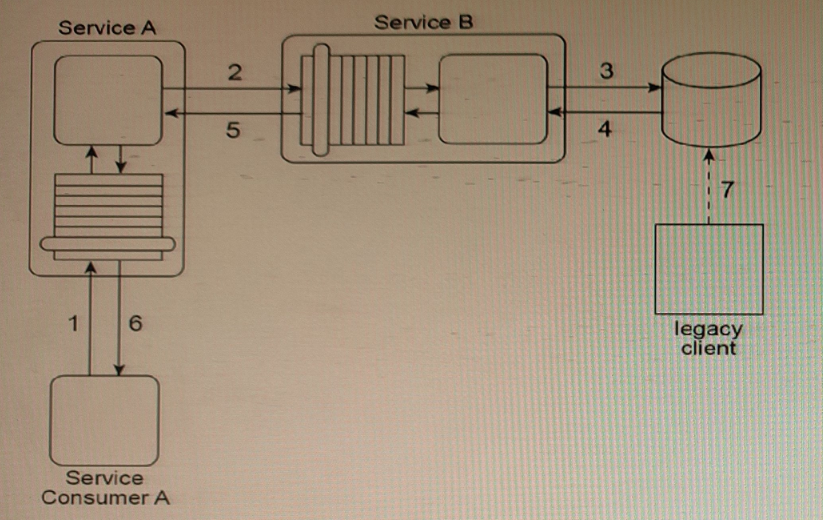
Service A is an entity service that provides a Get capability which returns a data value that is frequently changed.
Service Consumer A invokes Service A in order to request this data value (1). For Service A to carry out this request, it must invoke Service B (2), a utility service that interacts (3, 4) with the database in which the data value is stored. Regardless of whether the data value changed, Service B returns the latest value to Service A (5), and Service A returns the latest value to Service Consumer A (6).
The data value is changed when the legacy client program updates the database (7). When this change will occur is not predictable. Note also that Service A and Service B are not always available at the same time.
Any time the data value changes, Service Consumer A needs to receive It as soon as possible. Therefore, Service Consumer A initiates the message exchange shown In the figure several times a day. When it receives the same data value as before, the response from Service A Is ignored. When Service A provides an updated data value, Service Consumer A can process it to carry out its task.
The current service composition architecture is using up too many resources due to the repeated invocation of Service A by Service Consumer A and the resulting message exchanges that occur with each invocation.
What steps can be taken to solve this problem?
OptionsMultipleChoice
Refer to Exhibit.

Service A, Service B, and Service C are entity services, each designed to access the same shared legacy system. Service A manages order entities, Service B manages invoice entities, and Service C manages customer entities. Service A, Service B, and Service C are REST services and are frequently reused by different service compositions. The legacy system uses a proprietary file format that Services A, B, and C need to convert to and from.
You are told that compositions involving Service A, Service B, and Service C are unnecessarily complicated due to the fact that order, invoice, and customer entitles are all related to each other. For example, an order has a customer, an invoice has an order, and so on. This results In calls to multiple services to reconstruct a complete order document. You are asked to architect a solution that will simplify the composition logic by minimizing the number of services required to support simple business functions like order management or bill payment. Additionally, you are asked to reduce the amount of redundant data transformation logic that is found in Services A, B, and C.
How will you accomplish these goals?
OptionsMultipleChoice
Refer to Exhibit.

Service A sends a message to Service B (1). After Service B writes the message contents to Database A (2), it issues a response message back to Service A (3). Service A then sends a message to Service C (4). Upon receiving this message, Service C sends a message to Service D (5), which then writes the message contents to Database B (6) and issues a response message back to Service C (7).
Service A and Service D are located in Service Inventory
OptionsMultipleChoice
Refer to Exhibit.

Service Consumer A sends a message to Service A (1), which then forwards the message to Service B (2). Service B forwards the message to Service C (3), which finally forwards the message to Service D (4). However, Services A, B and C each contain logic that reads the contents of the message to determine what intermediate processing to perform and which service to forward the message to. As a result, what is shown in the diagram is only one of several possible runtime scenarios.
Currently, this service composition architecture is performing adequately, despite the number of services that can be involved in the transmission of one message. However, you are told that new logic is being added to Service A that will require it to compose one other service to retrieve new data at runtime that Service A will need access to in order to determine where to forward the message to. The involvement of the additional service will make the service composition too large and slow.
What steps can be taken to improve the service composition architecture while still accommodating the new requirements and avoiding an increase in the amount of service composition members?
OptionsMultipleChoice
Refer to Exhibit.
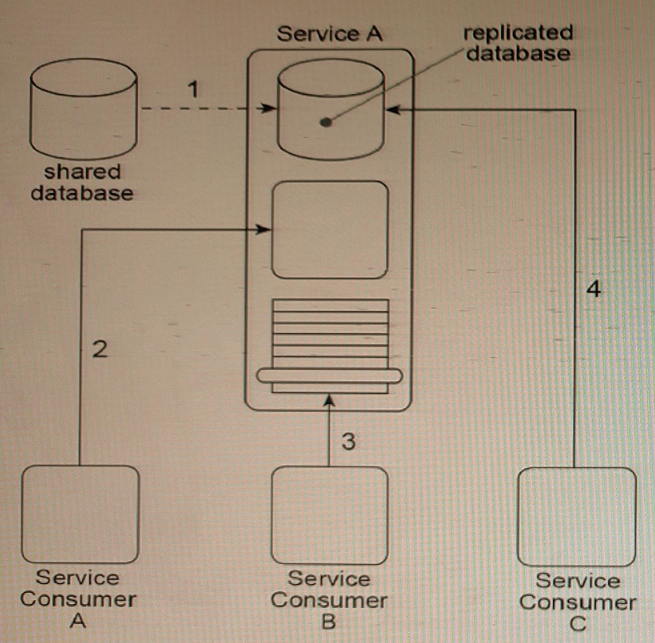
Service A is a utility service that provides generic data access logic to a database containing data that is periodically replicated from a shared database (1). Because the Standardized Service Contract principle was applied to the design of Service A, its service contract has been fully standardized.
The service architecture of Service A Is being accessed by three service consumers. Service Consumer A accesses a component that is part of the Service A Implementation by Invoking it directly (2). Service Consumer B invokes Service A by accessing Its service contract (3). Service Consumer C directly accesses the replicated database that Is part of the Service A Implementation (4).
You've been told that the reason Service Consumers A and C bypass the published Service A service contract is because, for security reasons, they are not allowed to access a subset of the capabilities in the API that comprises the Service A service contract. How can the Service A architecture be changed to enforce these security restrictions while avoiding negative forms of coupling?
OptionsMultipleChoice
Refer to Exhibit.
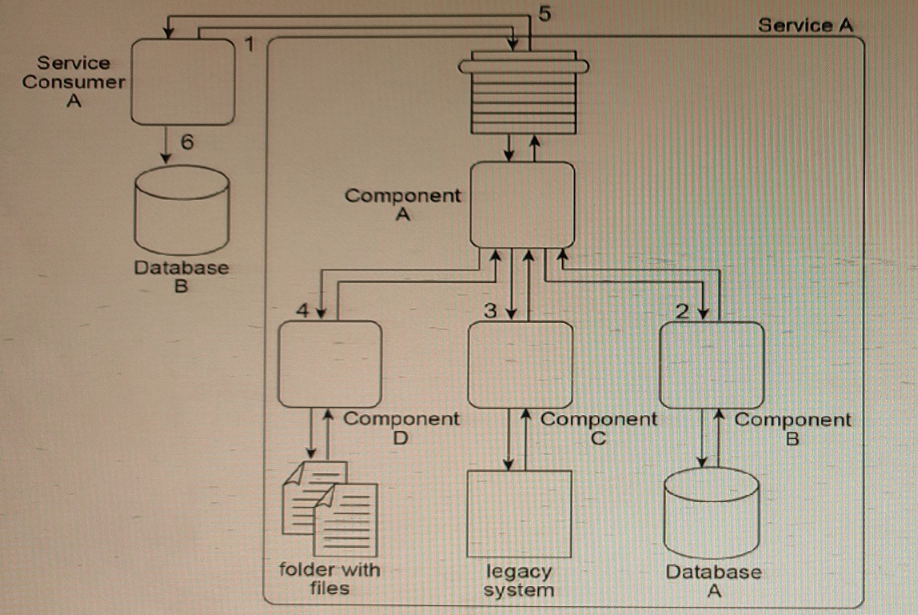
When Service A receives a message from Service Consumer A (1), the message is processed by Component
OptionsMultipleChoice
Refer to Exhibit.
Service A, Service B, and Service C are entity services, each designed to access the same shared legacy system. Service A manages order entities, Service B manages invoice entities, and Service C manages customer entities. Service A, Service B, and Service C are REST services and are frequently reused by different service compositions. The legacy system uses a proprietary file format that Services A, B, and C need to convert to and from.
You are told that compositions involving Service A, Service B, and Service C are unnecessarily complicated due to the fact that order, invoice, and customer entitles are all related to each other. For example, an order has a customer, an invoice has an order, and so on. This results In calls to multiple services to reconstruct a complete order document. You are asked to architect a solution that will simplify the composition logic by minimizing the number of services required to support simple business functions like order management or bill payment. Additionally, you are asked to reduce the amount of redundant data transformation logic that is found in Services A, B, and C.
How will you accomplish these goals?
OptionsMultipleChoice
Refer to Exhibit.
Service A sends a message to Service B (1). After Service B writes the message contents to Database A (2), it issues a response message back to Service A (3). Service A then sends a message to Service C (4). Upon receiving this message, Service C sends a message to Service D (5), which then writes the message contents to Database B (6) and issues a response message back to Service C (7).
Service A and Service D are located in Service Inventory
Options