
Free Preparation Discussions
 MENU
MENU
Arcitura Education S90.20 Exam - Topic 1 Question 6 Discussion
Topic #: 1
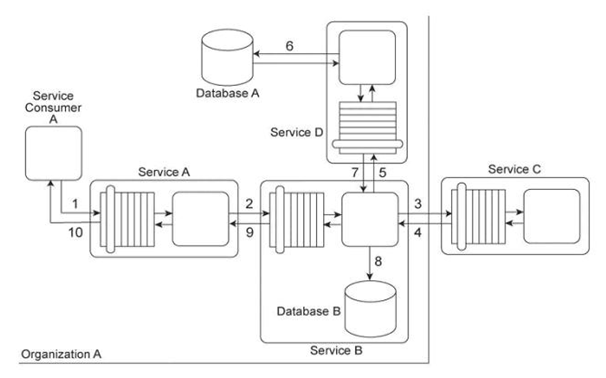
Service Consumer A sends a request message to Service A (1), after which Service A sends a request message to Service B (2). Service B forwards the message to have its contents calculated by Service C (3). After receiving the results of the calculations via a response message from Service C (4), Service B then requests additional data by sending a request message to Service D (5). Service D retrieves the necessary data from Database A (6), formats it into an XML document, and sends the response message containing the XML-formatted data to Service B (7). Service B appends this XML document with the calculation results received from Service C, and then records the entire contents of the XML document into Database B (8). Finally, Service B sends a response message to Service A (9) and Service A sends a response message to Service Consumer A (10). Services A, B and D are agnostic services that belong to Organization A and are also being reused in other service compositions. Service C is a publicly accessible calculation service that resides outside of the organizational boundary. Database A is a shared database used by other systems within Organization A and Database B is dedicated to exclusive access by Service B .Service B has recently been experiencing a large increase in the volume of incoming request messages. It has been determined that most of these request messages were auto-generated and not legitimate. As a result, there is a strong suspicion that the request messages originated from an attacker attempting to carry out denial-of-service attacks on Service B .Additionally, several of the response messages that have been sent to Service A from Service B contained URI references to external XML schemas that would need to be downloaded in order to parse the message data. It has been confirmed that these external URI references originated with data sent to Service B by Service C .The XML parser currently being used by Service A is configured to download any required XML schemas by default. This configuration cannot be changed. What steps can be taken to improve the service composition architecture in order to avoid future denial-of-service attacks against Service B and to further protect Service A from data access-oriented attacks?
Carmelina
10 months agoVirgie
10 months agoLouann
11 months agoCassi
11 months agoAnabel
11 months agoKeva
11 months agoAlecia
11 months agoSylvia
11 months agoLonny
11 months agoDahlia
11 months ago