
Deal of The Day! Hurry Up, Grab the Special Discount - Save 25% - Ends In 00:00:00 Coupon code: SAVE25
Welcome to Pass4Success

- Free Preparation Discussions

Arcitura Education S90.20 Exam - Topic 1 Question 30 Discussion

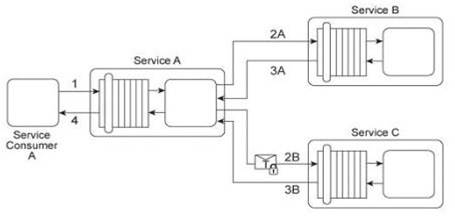
Service A is a publically accessible service that provides free multimedia retrieval capabilities to a range of service consumers. To carry out this functionality, Service A is first invoked by Service Consumer A (1). Based on the nature of the request message received from Service Consumer A, Service A either invokes Service B or Service C .When Service B is invoked by Service A (2A) it retrieves data from publicly available sources (not shown) and responds with the requested data (3A). When Service C is invoked by Service A (2B) it retrieves data from proprietary sources within the IT enterprise (not shown) and responds with the requested data (3B). After receiving a response from Service B or Service C, Service A sends the retrieved data to Service Consumer A (4). Service B does not require service consumers to be authenticated, but Service C does require authentication of service consumers. The service contract for Service A therefore uses WS-Policy alternative policies in order to express the two different authentication requirements to Service Consumer A .When Service Consumer A sends a request message (1), Service A determines whether the request requires the involvement of Service C and then checks to ensure that the necessary security credentials were received as part of the message. If the credentials provided by Service Consumer A are verified. Service A creates a signed SAML assertion and sends it with the request message to Service C (2B) This authentication information is protected by public key encryption However, responses to Service Consumer A's request message (3B, 4) are not encrypted for performance reasons. Recently, the usage of Service C has noticeably declined. An investigation has revealed response messages issued by Service C (3B) have been repeatedly intercepted and accessed by unauthorized and malicious intermediaries. As a result, Service Consumer A has lost confidence in the use of Service A for the retrieval of proprietary data because it is being viewed as a security risk. This is especially troubling, because the owner of Service A had planned to start charging a fee for Service A's ability to provide proprietary data via the use of Service C .How can this service composition architecture be changed to address the security problem with minimal impact on runtime performance?
C) Use the existing PKI to establish secure communication between Service Consumer A and Service C .A symmetric key can be generated for the data being sent from Service C to Service Consumer A Service C can generate a session key that is encrypted with Service Consumer A's public key. Service C can then attach the session key to the response message, which is encrypted using the session key. Because only Service Consumer A can decrypt the encrypted session key, the data transmitted in the message is safe from access by unauthorized intermediaries.
A) Use the existing PKI to provide message-layer security for the response messages originating from Service C .To provide-message confidentiality, Service C can encrypt the response messages using Service Consumer A's public key. This prevents unauthorized intermediaries from accessing the content of response messages.
B) Use the existing PKI to provide two-way authentication of the exchanged messages. After receiving a request from the service consumer, Service A can respond with a signed acknowledgement of the message, encrypted by the public key of Service Consumer A .Only Service Consumer A will be able to decrypt the encrypted acknowledgement. Service Consumer A then responds to the acknowledgement, thereby verifying its identity with Service A .Because both Service Consumer A and Service A are mutually authenticated, end-to-end transport-layer security is sufficient to provide message confidentiality in order to prevent unauthorized intermediaries from accessing messages originating from Service C .
D) Use the existing PKI to specify encryption and digital signature requirements on the messages. Service C can use Service-Consumer A's public key to generate a symmetric key. Service Consumer A can also generate the same session key from its own public key. Service C can use the session key to encrypt the response message (and the hash value of the response message), concatenate them, and send them to Service Consumer A .Service Consumer A separates the concatenated and encrypted hash value, decrypts it, and then decrypts the encrypted response message. As a result, the confidentiality and integrity of the response message are guaranteed.

Arcitura Education S90.20 Exam - Topic 1 Question 30 Discussion

Actual exam question for Arcitura Education's S90.20 exam
Question #: 30
Topic #: 1
[All S90.20 Questions]

Service A is a publically accessible service that provides free multimedia retrieval capabilities to a range of service consumers. To carry out this functionality, Service A is first invoked by Service Consumer A (1). Based on the nature of the request message received from Service Consumer A, Service A either invokes Service B or Service C .When Service B is invoked by Service A (2A) it retrieves data from publicly available sources (not shown) and responds with the requested data (3A). When Service C is invoked by Service A (2B) it retrieves data from proprietary sources within the IT enterprise (not shown) and responds with the requested data (3B). After receiving a response from Service B or Service C, Service A sends the retrieved data to Service Consumer A (4). Service B does not require service consumers to be authenticated, but Service C does require authentication of service consumers. The service contract for Service A therefore uses WS-Policy alternative policies in order to express the two different authentication requirements to Service Consumer A .When Service Consumer A sends a request message (1), Service A determines whether the request requires the involvement of Service C and then checks to ensure that the necessary security credentials were received as part of the message. If the credentials provided by Service Consumer A are verified. Service A creates a signed SAML assertion and sends it with the request message to Service C (2B) This authentication information is protected by public key encryption However, responses to Service Consumer A's request message (3B, 4) are not encrypted for performance reasons. Recently, the usage of Service C has noticeably declined. An investigation has revealed response messages issued by Service C (3B) have been repeatedly intercepted and accessed by unauthorized and malicious intermediaries. As a result, Service Consumer A has lost confidence in the use of Service A for the retrieval of proprietary data because it is being viewed as a security risk. This is especially troubling, because the owner of Service A had planned to start charging a fee for Service A's ability to provide proprietary data via the use of Service C .How can this service composition architecture be changed to address the security problem with minimal impact on runtime performance?

Show Suggested Answer Hide Answer
Suggested Answer: C

Contribute your Thoughts:

0/2000 characters
Reta
7 months ago
What if the session key gets intercepted too?
upvoted 0 times
...
Lynelle
7 months ago
Totally agree, encryption is a must for sensitive data!
upvoted 0 times
...
Golda
7 months ago
Wait, can we really trust the existing PKI for this?
upvoted 0 times
...
Olga
8 months ago
I think option C is the best way to go.
upvoted 0 times
...
Odette
8 months ago
Sounds like Service C really needs better security measures!
upvoted 0 times
...
Maryann
8 months ago
I recall that two-way authentication can enhance security. Option B seems like it could work, but I wonder if it would really prevent unauthorized access effectively.
upvoted 0 times
...
Adrianna
8 months ago
I’m a bit confused about the differences between the options. I think D sounds comprehensive, but it seems like it might add complexity to the process.
upvoted 0 times
...
Lilli
8 months ago
This question feels similar to one we practiced on encryption methods. I think option C, with the session key, might provide a good balance between security and performance.
upvoted 0 times
...
Eura
8 months ago
I remember studying about using PKI for message security, but I'm not sure if encrypting the response messages with the consumer's public key is the best approach.
upvoted 0 times
...
Nana
8 months ago
Subtle thought control? Really? I'm pretty sure that's not a real option (C). I'm leaning towards B, but I want to double-check the details before I commit to an answer.
upvoted 0 times
...
Jonelle
8 months ago
This seems like a straightforward question about ODI Agent configuration. I'm pretty confident I can figure this out.
upvoted 0 times
...

Save Cancel