Arcitura Education S90.20 Exam - Topic 1 Question 27 Discussion
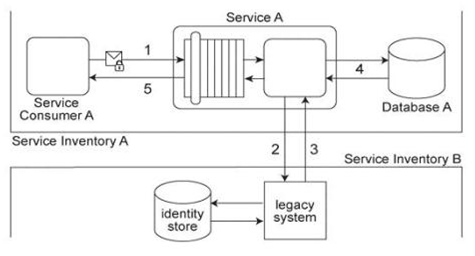
Service Consumer A submits a request message with security credentials to Service A (1). The identity store that Service A needs to use in order to authenticate the security credentials can only be accessed via a legacy system that resides in a different service inventory. Therefore, to authenticate Service Consumer A, Service A must first forward the security credentials to the legacy system (2). The legacy system then returns the requested identity to Service A (3). Service A authenticates Service Consumer A against the identity received from the legacy system. If the authentication is successful, Service A retrieves the requested data from Database A (4), and returns the data in a response message sent back to Service Consumer A (5). Service A belongs to Service Inventory A which further belongs to Security Domain A and the legacy system belongs to Service Inventory B which further belongs to Security Domain B .(The legacy system is encapsulated by other services within Service Inventory B, which are not shown in the diagram.) These two security domains trust each other. Communication between Service A and the legacy system is kept confidential using transport-layer security. No intermediary service agents currently exist between the two service inventories. However, it has been announced that due to the introduction of new systems, some intermediary service agents may be implemented in the near future. Additionally, the legacy system has been scheduled for retirement and will be replaced by a new identity management system that will provide a new identity store. Because the new identity store will need to serve many different systems, there are concerns that it could become a performance bottleneck. As a result, services (including Service A and other services in Security Domains A and B) will not be allowed to directly access the new identity store. Which of the following statements describes a solution that can accommodate the requirements of the new identity store, the authentication requirements of Service A, and can further ensure that message exchanges between Security Domains A and B remain confidential after intermediary service agents are introduced?
D) Apply the Brokered Authentication pattern to establish an authentication broker. Instead of Service A directly authenticating-Service Consumer A, Service Consumer A submits a request message with security credentials to the authentication broker, which authenticates Service Consumer A against the new identity store and then issues a SAML token to Service Consumer A that it can use for message exchanges with other services, if necessary. In order to secure cross-service inventory message exchanges, the Data Confidentiality pattern is applied to establish message-layer security.
A) Apply the Trusted Subsystem pattern to implement a utility service abstracting the new identity management system. Service A forwards Service Consumer As credentials to the utility service to verify Service Consumer As identity. The utility service authenticates the request originating from Service A .After successful authentication, the utility service uses its own credentials to retrieve the requested identity, and then send the identity to Service A, Therefore, effectively reducing the processing need of the identity management system. The current transport-layer security can still be used, in order to secure the communication between Service A and the new utility service, as it more efficient than the message-layer security.
B) Apply the Trusted Subsystem pattern by abstracting away the new identity management system using a utility service that authenticates the request from Service A and then uses its own credentials to retrieve the requested identity from the new identity management system. For the utility service to authenticate Service As request, it needs to be provisioned with a new identity database that contains identities for all authorized service consumers of the new utility service. In order to secure the communication between Service A and the new utility service, use message-layer security as it provides security over multiple hops considering the need to secure the message in case an intermediary is introduced in future.
C) Replicate the identity database used by the new identity management system. Because the Security Domains A and B trust each other, protection of the identity store is guaranteed. Use Service Agents to monitor changes to the identity database used by the new identity management system and to update the replica. This would satisfy the security needs of Service A, would eliminate the need to request services from Service Inventory B, and ensure that current identity information is available for Service A .Because Service A would not need to access services across different trust domains, the current transport-layer security is sufficient.

 MENU
MENU
Blondell
10 months agoChanel
10 months agoMartina
10 months agoBerry
11 months agoFranchesca
11 months agoMica
11 months agoAudry
11 months agoAdela
11 months agoSalley
11 months agoTamar
11 months agoPearly
11 months ago