Arcitura Education S90.20 Exam - Topic 1 Question 18 Discussion
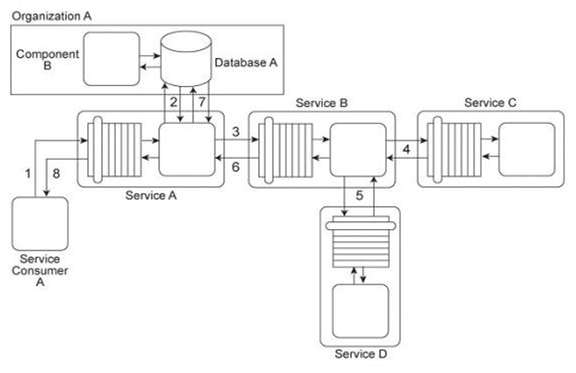
Service Consumer A sends a request message to Service A (1) after which Service A retrieves financial data from Database A (2). Service A then sends a request message with the retrieved data to Service B (3). Service B exchanges messages with Service C (4) and Service D (5), which perform a series of calculations on the data and return the results to Service A .Service A uses these results to update Database A (7) and finally sends a response message to Service Consumer A (8). Component B has direct, independent access to Database A and is fully trusted by Database A .Both Component B and Database A reside within Organization A .Service Consumer A and Services A, B, C, and D are external to the organizational boundary of Organization A .Component B is considered a mission critical program that requires guaranteed access to and fast response from Database A .Service A was recently the victim of a denial of service attack, which resulted in Database A becoming unavailable for extended periods of time (which further compromised Component B). Additionally, Services B, C, and D have repeatedly been victims of malicious intermediary attacks, which have further destabilized the performance of Service A .How can this architecture be improved to prevent these attacks?
A) A utility service is created to encapsulate Database A and to assume responsibility for authenticating all access to the database by Service A and any other service consumers. Due to the mission critical requirements of Component B, the utility service further contains logic that strictly limits the amount of concurrent requests made to Database A from outside the organizational boundary. The Data Confidentiality and Data Origin Authentication patterns are applied to all message exchanged within the external service composition in order to establish message-layer security.
B) Service Consumer A generates a private/public key pair and sends this public key and identity information to Service A .Service A generates its own private/public key pair and sends it back to Service Consumer A .Service Consumer A uses the public key of Service A to encrypt a randomly generated session key and then sign the encrypted session key with the private key. The encrypted, signed session key is sent to Service A .Now, this session key can be used for secure message-layer communication between Service Consumer A and Service A .The Service Perimeter Guard pattern is applied to establish a perimeter service that encapsulates Database A in order to authenticate all external access requests.
C) Services B, C, and D randomly generate Session Key K, and use this key to encrypt request and response messages with symmetric encryption. Session Key K is further encrypted itself asymmetrically. When each service acts as a service consumer by invoking another service, it decrypts the encrypted Session Key K and the invoked service uses the key to decrypt the encrypted response. Database A is replicated so that only the replicated version of the database can be accessed by Service A and other external service consumers.
D) The Direct Authentication pattern is applied so that when Service Consumer A submits security credentials, Service A will be able to evaluate the credentials in order to authenticate the request message. If the request message is permitted, Service A invokes the other services and accesses Database A .Database A is replicated so that only the replicated version of the database can be accessed by Service A and other external service consumers.

 MENU
MENU
Tammara
10 months agoDorothy
10 months agoIraida
11 months agoBarney
11 months agoAzzie
11 months agoGeorgeanna
11 months agoBrice
11 months agoLanie
11 months agoCristal
11 months agoSalome
11 months ago