Arcitura Education S90.20 Exam - Topic 1 Question 15 Discussion
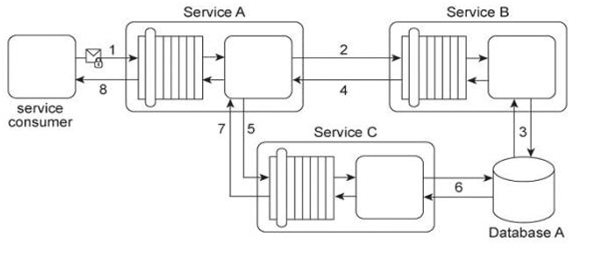
Service A provides a customized report generating capability. Due to infrastructure limitations, the number of service consumers permitted to access Service A concurrently is strictly controlled. Service A validates request messages based on the supplied credentials (1). If the authentication of the request message is successful, Service A sends a message to Service B (2) to retrieve the required data from Database A (3). Service A stores the response from Service B (4) in memory and then issues a request message to Service C (5). Service C retrieves a different set of data from Database A (6) and sends the result back to Service A (7). Service A consolidates the data received from Services B and C and sends the generated report in the response message to its service consumer (8).This service composition was recently shut down after it was discovered that Database A had been successfully attacked twice in a row. The first type of attack consisted of a series of coordinated request messages sent by the same malicious service consumer, with the intention of triggering a range of exception conditions within the database in order to generate various error messages. The second type of attack consisted of a service consumer sending request messages with malicious input with the intention of gaining control over the database server. This attack resulted in the deletion of database records and tables. An investigation revealed that both attacks were carried out by malicious service consumers that were authorized. How can the service composition security architecture be improved to prevent these types of attacks?
C) Apply the Exception Shielding pattern together with the Message Screening pattern. This establishes new logic within Service A that screens incoming request messages for data-driven attacks (such as SQL injection and X-Path injection attacks), and also evaluates whether exception details returned by Database A contains potentially confidential or unsafe information. Any inappropriate exception information is replaced with sanitized content.
A) Apply the Data Confidentiality pattern together with the Data Origin Authentication pattern. This establishes message-level-security so that all messages are encrypted and digitally signed. Secondly, the Service A logic must be enhanced so that it can keep track of the trustworthiness of its service consumers If a request message originated from a trustworthy service consumer, then the request message is processed as normal. If the request message originates from a non-trustworthy service consumer, then the request message is rejected and an error message is returned to the service consumer.
B) Apply the Service Perimeter Guard pattern together with the Trusted Subsystem pattern. This establishes a perimeter service between Database A and any service that requires access to it (including Services B and C). The perimeter service evaluates incoming data requests and filters out those that can introduce a security risk. Only request messages issued by authorized services and service consumers are forwarded to Database A .Responses originating from Database A are further evaluated by the trusted subsystem to remove any unauthorized data. The two patterns together ensure that only authorized data is returned to the service consumer and that no request messages present a security threat to Database A.
D) Apply the Trusted Subsystem pattern to protect Database A from data-driven attacks and to evaluate whether database-responses contain inappropriate data. The trusted subsystem maintains a snapshot of Database A and executes the original service consumer's request message against the snapshot. The processing logic that accesses the snapshot has limited privileges in order to prevent malicious attacks from overtaking the database. If no security violation is detected during the processing of the snapshot, then the original service consumer's request is forwarded to Database A .If an error message is generated during the processing of the snapshot, then it is returned to the original service consumer and the request is not forwarded to Database A .Because the error message was generated on the snapshot, it cannot contain unsafe information about Database A.

 MENU
MENU
Hubert
10 months agoMeghan
10 months agoArmando
11 months agoLavelle
11 months agoMalcom
11 months agoSamira
11 months agoFairy
11 months agoNoel
11 months ago