Free Preparation Discussions
 MENU
MENU
Free Arcitura Education C90.03 Exam Dumps August 2026
Here you can find all the free questions related with Arcitura Education Cloud Technology Lab (C90.03) exam. You can also find on this page links to recently updated premium files with which you can practice for actual Arcitura Education Cloud Technology Lab Exam. These premium versions are provided as C90.03 exam practice tests, both as desktop software and browser based application, you can use whatever suits your style. Feel free to try the Cloud Technology Lab Exam premium files for free, Good luck with your Arcitura Education Cloud Technology Lab Exam.MultipleChoice
Organization A has been expanding and, as a result, is outgrowing the processing capacity of its on-premise Service A implementation. It is determined that this is due to usage thresholds of Service A and complex data processing limitations in Database A . The diagram depicts Organization A's current on-premise environment, where Service Consumers A . B and C attempt to access Service A at the same time. Service Consumer A successfully accesses Service A, which then successfully retrieves the requested data (1). Service Consumer B successfully accesses Service A, but due to the complex data structure, the request for the data times out and fails (2). Finally, Service Consumer C attempts to access Service A, but is rejected because Service A is unable to accept more concurrent requests.

Organization A is required to continue using its on-premise Service A implementation, with the exception of Database A, which does not need to remain on-premise. Database A is dedicated to Service A and is comprised of relational data. Which of the following statements provides a solution that uses cloud-based IT resources to solve the performance limitations of Service A and Database A?
OptionsMultipleChoice
Cloud Provider X (which owns Cloud X) deploys two physical servers (Physical Servers A and B) and two databases (Databases A and B). Virtual Servers A and B are hosted by Physical Server A and Ready-Made Environments A and B are hosted by Virtual Server B . Virtual Servers C and D are hosted by Physical Server B . Cloud Service Consumer A regularly accesses Virtual Server D in order to test and deploy a new cloud service that was developed on-premise by the cloud consumer organization operating Cloud Service Consumer A . Cloud Service Consumer B (operated by a different cloud consumer organization) has been regularly accessing Ready-Made Environment A in order to develop and deploy a different new cloud service. The cloud consumer organizations that own and operate Cloud Service Consumers A and B will soon be ready to launch their respective cloud services for use by their customers. Both cloud consumer organizations are concerned that Cloud X does not provide sufficient security and they demand that Cloud Provider X take the necessary steps to mitigate the denial of service, insufficient authorization and overlapping trust boundaries security threats.

Which of the following statements accurately describes the cloud delivery models used now by the cloud service consumers and in the future by their customers - and - further describes a solution that fulfills the identified security requirements by implementing a single cloud security mechanism?
OptionsMultipleChoice
Cloud Service A is being made available on public Cloud X by Cloud Provider X via the SaaS delivery model. Cloud Service A is hosted by Physical Server A that also hosts cloud services being used by different cloud service consumers (and owned by different cloud service owners). Cloud Service Consumers A and B access Cloud Service A on a regular basis and Physical Server A has been able to accommodate the resulting usage load After reviewing the implementation environment for Cloud Service A . Cloud Provider X determines it needs to enhance the ubiquitous access and multi-tenancy characteristics within this part of Cloud X.

Which of the following statements accurately describes a solution that fulfills all of these requirements?
OptionsMultipleChoice
The cloud service owner of Cloud Service A is evaluating Clouds X, Y and Z to determine which cloud environment can offer the greatest level of reliability. All three clouds are geographically dispersed across three separate time zones. As a result, each cloud experiences usage peaks at different times. Based on the metrics provided, the greater the usage of a cloud, the lower its reliability. When the cloud service owner complains to Cloud Provider A (the owner of all three clouds) that none of the clouds provide an adequate level of reliability, Cloud Provider A suggests a solution that increases resiliency.
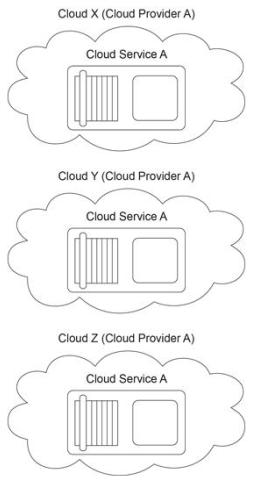
Which of the following statements accurately describes a solution that can be used to fulfill the resiliency requirements of Cloud Service A?
OptionsMultipleChoice
Organization A has been expanding and, as a result, is outgrowing the processing capacity of its on-premise Service A implementation. It is determined that this is due to usage thresholds of Service A and complex data processing limitations in Database A . The diagram depicts Organization A's current on-premise environment, where Service Consumers A . B and C attempt to access Service A at the same time. Service Consumer A successfully accesses Service A, which then successfully retrieves the requested data (1). Service Consumer B successfully accesses Service A, but due to the complex data structure, the request for the data times out and fails (2). Finally, Service Consumer C attempts to access Service A, but is rejected because Service A is unable to accept more concurrent requests.

Organization A is required to continue using its on-premise Service A implementation, with the exception of Database A, which does not need to remain on-premise. Database A is dedicated to Service A and is comprised of relational data. Which option best statements provides a solution that uses cloud-based IT resources to solve the performance limitations of Service A and Database A?
OptionsMultipleChoice
A cloud consumer is interested in leasing cloud-based virtual servers. It compares the virtual servers offered by Cloud Provider X and Cloud Provider Y. Cloud X (owned by Cloud Provider X) and Cloud Y (owned by Cloud Provider Y) both provide shared physical servers that host multiple virtual servers for other cloud consumers. The virtual servers on Cloud X are accessed directly, whereas the virtual servers on Cloud Y are accessed via an automated scaling listener. On Cloud X, virtual servers are pre-configured to support a specific amount of concurrent cloud service consumers. When this threshold is exceeded, cloud service consumer requests are rejected. Due to the use of the automated scaling listener, virtual servers on Cloud Y can provide a greater level of elasticity. The hourly cost to the cloud consumer to use a virtual server on Cloud X is half that of the cost to use a virtual server on Cloud Y. Within a one month period, Cloud Provider X bases its hourly charge on the maximum number of virtual servers used. Within a one month period, Cloud Provider Y bases its hourly charges on actual virtual server usage. Cloud Provider Y charges $20 for each hour that a cloud consumer uses a virtual server.
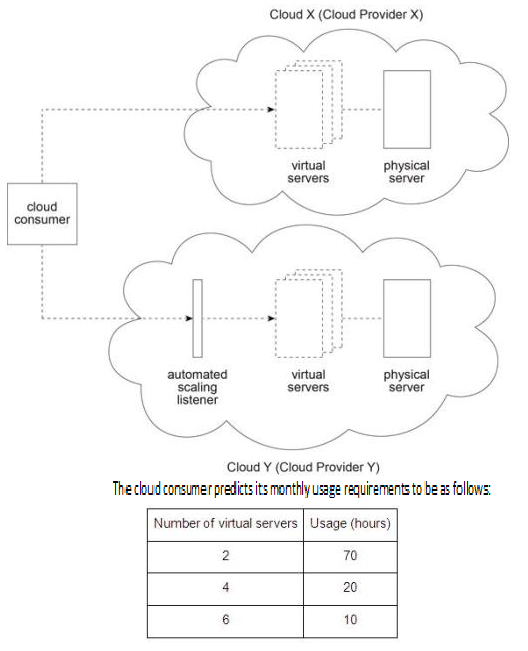
The cloud consumer is required choose the cloud provider with the lowest on-going cost based on its predicted usage. Which of the following statements accurately calculates the on-going usage costs of Cloud Providers X and Y and correctly states the cloud provider that the cloud consumer must choose?
OptionsMultipleChoice
Organization A has been expanding and, as a result, is outgrowing the processing capacity of its on-premise Service A implementation. It is determined that this is due to usage thresholds of Service A and complex data processing limitations in Database A . The diagram depicts Organization A's current on-premise environment, where Service Consumers A . B and C attempt to access Service A at the same time. Service Consumer A successfully accesses Service A, which then successfully retrieves the requested data (1). Service Consumer B successfully accesses Service A, but due to the complex data structure, the request for the data times out and fails (2). Finally, Service Consumer C attempts to access Service A, but is rejected because Service A is unable to accept more concurrent requests.
Organization A is required to continue using its on-premise Service A implementation, with the exception of Database A, which does not need to remain on-premise. Database A is dedicated to Service A and is comprised of relational data. Which of the following statements provides a solution that uses cloud-based IT resources to solve the performance limitations of Service A and Database A?
OptionsMultipleChoice
Cloud Provider X (which owns Cloud X) deploys two physical servers (Physical Servers A and B) and two databases (Databases A and B). Virtual Servers A and B are hosted by Physical Server A and Ready-Made Environments A and B are hosted by Virtual Server B . Virtual Servers C and D are hosted by Physical Server B . Cloud Service Consumer A regularly accesses Virtual Server D in order to test and deploy a new cloud service that was developed on-premise by the cloud consumer organization operating Cloud Service Consumer A . Cloud Service Consumer B (operated by a different cloud consumer organization) has been regularly accessing Ready-Made Environment A in order to develop and deploy a different new cloud service. The cloud consumer organizations that own and operate Cloud Service Consumers A and B will soon be ready to launch their respective cloud services for use by their customers. Both cloud consumer organizations are concerned that Cloud X does not provide sufficient security and they demand that Cloud Provider X take the necessary steps to mitigate the denial of service, insufficient authorization and overlapping trust boundaries security threats.
Which of the following statements accurately describes the cloud delivery models used now by the cloud service consumers and in the future by their customers - and - further describes a solution that fulfills the identified security requirements by implementing a single cloud security mechanism?
Options