
Free Preparation Discussions
 MENU
MENU
Appian ACD201 Exam Questions
- Topic 1: Data Management: This section of the exam measures the skills of Solution Architects and covers designing and documenting data models, recommending record types for optimization and security, working with relational data, and implementing complex models with supporting objects.
- Topic 2: Application Design and Development: This section of the exam measures the skills of Appian Developers and covers translating business requirements into user stories, building end-to-end applications, managing object security, applying design best practices, and ensuring user-centric experiences through proper UX design.
- Topic 3: Advanced Appian Concepts: This section of the exam measures the skills of Solution Architects and covers creating and configuring authentication methods, setting up integration objects, designing APIs, evaluating smart services and plug-ins, and applying SSO mechanisms with SAML and LDAP.
- Topic 4: Performance and Scalability: This section of the exam measures the skills of Appian Developers and covers designing performant components, building memory-efficient models, conducting database load and automated testing, analyzing server memory and logs for risks, and resolving performance concerns for end users.
Free Appian ACD201 Exam Actual Questions
Note: Premium Questions for ACD201 were last updated On Sep. 19, 2026 (see below)
You're building an order management system.
You need to create a field that displays the total number of days it took to deliver each order, and show and sort by this data in a read-only grid. The data must be available in real-time.
Which function is the most appropriate for calculating this value?
a!customFieldDateDiff() is specifically designed for calculating date differences as custom record fields, enabling sorting and real-time calculation in read-only grids.
You need to add test cases to an existing expression rule in the system. Expression rule gives a complex data type value as an output result.
The test case should pass only when a field in the resultant data matches with a specific value mentioned.
How should you configure the test case assertion?
Configuring the test case assertion so that the assertion expression evaluates to True allows you to specifically check whether the desired field in the complex data type result matches the required value.
You're creating a point-of-sale (POS) system for a customer which can associate the items in a transaction to a customer based on a membership number. The item stock table and the customer sales record are hosted elsewhere and need to be written to via POST APIs from an Appian process model. This all occurs within a transaction process model that you're creating.
Which two steps should you perform to design your process model to improve process memory? (Choose two.)
Creating the POST API calls as asynchronous subprocesses allows them to run independently, reducing memory usage in the main process.
Adding a terminate process node at the end ensures the process completes and releases memory as soon as its work is finished.
You're designing a process used to notify multiple users of marketing campaigns. These campaigns occur infrequently, but are sent out to the hundreds of customers that are stored in your app.
How should you best design your process model to send the emails whilst using a common email process model (CMN_SendEmail), to be most performant?
The outputs of this node are not required for the main process.
Using 'Start Process' as the node type and enabling 'Automatically run multiple instances of this node' for all users on the mailing list launches each email as a separate, lightweight process, maximizing performance and scalability, especially since the main process does not require the outputs.
You're designing a custom component rule!pagingComponent() to page through a list of items. The component must display the current page numbers being shown, as well as the total number of items. Users should be able to click arrows to increase or decrease the pagination.
Review the following:
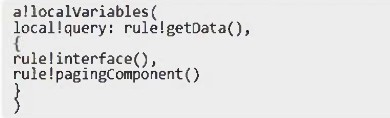
Which two patterns should be used when calling the component in this scenario? (Choose two.)
Passing local!query.totalCount (from a dataSubset with returnTotalCount: true) into a rule input allows rule!pagingComponent() to accurately display total items for pagination.
Managing paging state (such as ri!pagingInfo) as a local variable in the main interface and updating it when arrows are clicked ensures that pagination is controlled centrally, maintaining state across the UI and allowing the component to function as intended.
- Select Question Types you want
- Set your Desired Pass Percentage
- Allocate Time (Hours : Minutes)
- Create Multiple Practice tests with Limited Questions
- Customer Support
Brian King
14 days agoMatthew Moore
24 days agoMargaret Flores
1 month agoCrystal Peterson
2 months agoMichael Walker
3 months agoEric Anderson
3 months agoRyan Thompson
4 months agoCharles Flores
4 months agoJustin Rodriguez
4 months agoDaniel Young
5 months agoJoseph Martinez
5 months agoJames Turner
4 months agoEric Harris
4 months agoTimothy Bell
4 months agoBarney
6 months agoGracia
6 months agoJesusa
6 months agoAdelaide
6 months agoTasia
7 months agoViva
7 months agoGregoria
7 months agoSkye
7 months agoCyril
8 months agoLoreta
8 months agoSheridan
8 months agoGearldine
8 months agoCristal
9 months agoRosina
9 months agoHildred
9 months agoCallie
9 months agoGayla
10 months agoWendell
10 months agoLuis
10 months agoJacquline
10 months agoAmie
11 months agoRose
11 months agoEdwin
11 months agoLettie
11 months agoEliz
12 months agoLuisa
12 months agoNa
12 months agoAlberta
12 months agoBev
1 year agoAlbina
1 year agoEdward
1 year ago