
Free Preparation Discussions
 MENU
MENU
AIWMI CCRA-L2 Exam Questions
- Topic 1: Preparation of Credit Proposal and Credit Appraisal, Capital Budgeting Methods/ CRA Regulations and Debt Guidelines
- Topic 2: Bond Valuation Measures including Swaps, OAS, YTW, YTM/ Classification of Investments in Financial Assets
- Topic 3: Loan documentation, Covenants analysis and Trends/ Ratings For Financial Institutions And Banks, Sovereign Ratings, Internal Rating models(Basel)
- Topic 4: Understanding Credit Spreads, Trading on Credit Spreads/ Ratio Analysis, Financial Modelling and Covenant Testing
- Topic 5: Credit Monitoring and Identification of Early Warning Signals/ Assessment of Working Capital Finance, Analyze Treasuries and other corporate papers
- Topic 6: Nuances of Accounting: Inventories, Depreciation, EPS, Intangible Assets/ Analysis in a Multi Asset Class portfolio
- Topic 7: Nuances of Leases, Hire Purchase, Pension Liabilities/ Rating of Asset Backed and Mortgage Backed Securitization Transactions
- Topic 8: Nuances of Credit Analysis from NBFC Perspective, Private Banking perspective, ARCPerspective/ Risk Mitigation using derivatives like swaps, FRA, caps and floors, Forex Hedge
- Topic 9: Trading Strategies for Emerging Markets/ Ratings Methodology For Manufacturing Companies/ Understanding and analysis of Corporate Banking Facilities and other financing forms
Free AIWMI CCRA-L2 Exam Actual Questions
Note: Premium Questions for CCRA-L2 were last updated On Sep. 15, 2026 (see below)
Scott is a credit analyst with one of the credit rating agencies in Indi
a. He was looking in Oil and Gas Industry companies and has presented brief financials for following 4 entities:
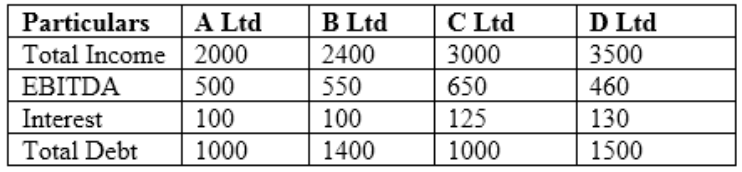
From the data given below, calculate the standard deviation of the credit portfolio assuming that facility's exposure is known with certainty, customer defaults and LGDs are independent of one another and LGDs are independent across borrower(s).
Credit Facility A -- Loss Equivalent Exposure of $60m, expected Default frequency of 1.5%, loss given default
of 30%, Std Deviation of LGD -- 5% and Correlation to portfolio -- 0.10
Credit Facility B -- Loss Equivalent Exposure of $25m, expected Default frequency of 2%, loss given default of 12%, Std Deviation of LGD -- 12% and Correlation to portfolio -- 0.45
Credit Facility C -- Loss Equivalent Exposure of $15m, expected Default frequency of 5%, loss given default of 85%, Std Deviation of LGD -- 18% and Correlation to portfolio -- 0.22
Scott is a credit analyst with one of the credit rating agencies in Indi
a. He was looking in Oil and Gas Industry companies and has presented brief financials for following 4 entities:
Two credit analysts are discussing the DM-approach to credit risk modeling. They make the following statements:
Analyst A: A portfolio's standard deviation of credit losses can be determined by considering the standard deviation of credit losses of individual exposures in the portfolio and summing them all up.
Analyst B: I do not fully agree with that. Apart from individual standard deviations, one also needs to consider the correlation of the exposure with the rest of the portfolio so as to account for diversification effects. Higher correlations among credit exposures will lead to higher standard deviation of the overall portfolio.
Mark Construction Company (MCC) has bagged a contract for construction of a large dam and hydro power project on river Shivna in Madhya Pradesh (MP). The project is also of relevance from the irrigation perspective due to its location and as per the agreement MCC will have to undertake construction of web of canals, approach road to dam, power house and other ancillary units. MCC is promoted by Mr. Thomas Mark, who is a MP from the ruling party which recently formed government in MP. Historically, MCC has been engaged into construction of rural roads, small bridges and railway platforms on contract basis for the Government. MCC will have a separate special purpose vehicle (SPV) floated for this venture.
The hydro power project comes under the public private partnership scheme of the Government of MP, where in the private partner builds owns operates and transfers (BOOT) the hydro power plant. The detailed terms of the hydro power project agreement are as follows:
1. The construction of the dam, canals and hydro power plant shall be undertaken by the contractor. The
Government of MP will have to acquire land which will submerge on construction of dam and shall rehabilitate the owners of land.
2. MCC shall have right to operate the hydro power project from date of commencement of commercial operations (DCCO) for a period of 20 years and shall transfer the project to Government thereafter. Further,
SPV shall be tax exempt for a period of five years from DCCO i.e. FY17-FY21.
3. The power project is of 600 megawatts (MW) shall comprise 4 units of 150 MW each. The estimated cost of project is about INR3, 500 Million to be spent over a period of 4 year(s) the project is estimated to be commercially operational by April 1, 2016 with two units operational om same day and one unit each will be operational on April 1, 2017 and April 1, 2018.
4. Means of finance:

Means of Finance INR Million
Government Aid (To be classified as Equity) 500Equity 900 Debt 2100
5. Amount if expenditure estimated in various years is as follows:

Debt shall bear a fixed rate of interest of 10% and all interest till DCCO shall be added to the principal. The expected principal along with capitalized interest is expected to be INR2, 400 Million (i.e.INR2100 Million debtplus INR300 Million capitalized interest). The repayment of the same shall be in 12 equated annual installments starting from FY17.
Brief projections for the period of FY17 to FY21 are given below:

Developments as on March 31, 2015
The project manager for the SPV made following comments at a press conferee on March 31, 2015:
As you all are aware, we were running bang on schedule till we last met on December 21, 2014. From today we are just left with one more year to complete the project in time. However, the flash floods which struck our dam site on this March 15, 2015 have created havoc in the region. I shall not point out the loss of lives in the region as you all are well aware of those. Our project has also been badly hit due to the same and we have been assessing the damage over the last one week. After analyzing damage, we have made changes in project schedule. Now we will be making only one unit of 150 MW operational on April 1, 2016 and 1 unit each will be added in each of subsequent year(s).
Development as on September 30, 2015
Post the flash floods, lot of environmentalists started raising issues of changes in environment due to construction of large number of dams. A few Public Interest Litigations (PILs) have been filed in various courts.
Honorable High Court of MP on September 27, 2015, banned construction of any dams in the region and banned permissions for new dams till next hearing scheduled on November 30, 2015. MCC in its press release has indicated that they will apply to the higher court on the matter.
As a credit rating analyst on September 30, 2015, on receipt of the high court order, what rating action you will take:
Ms. Mary Brown is a credit rating analyst. She had prepared a detailed report on one of her client, FlyHigh
Airlines Ltd, a company operating chartered aircrafts in Indi
a. As she was heading for a meeting with her superior on the matter, coffee spilled over her set of prepared paper(s). As she was getting late for meeting, instead of preparing entire set she could recollect few numbers from her memory and reconstructed following partial financial table:

An analyst comparing two competitors Comp Systems and Big Tables gathers the data below:
Cash Conversions Cycle:
Comp Systems: 18 days and Big Tables 32 days
Defense Interval Ratio:
Comp Systems: 50 and Big Tables: 20
What can the analyst conclude regarding the liquidity of these companies?
Ms. Mary Brown is a credit rating analyst. She had prepared a detailed report on one of her client, FlyHigh
Airlines Ltd, a company operating chartered aircrafts in Indi
a. As she was heading for a meeting with her superior on the matter, coffee spilled over her set of prepared paper(s). As she was getting late for meeting, instead of preparing entire set she could recollect few numbers from her memory and reconstructed following partial financial table:

PAT margins are highest in which of the years?
- Select Question Types you want
- Set your Desired Pass Percentage
- Allocate Time (Hours : Minutes)
- Create Multiple Practice tests with Limited Questions
- Customer Support
Joseph Cook
1 day agoAmanda Davis
17 days agoAngela Rogers
1 month agoDaniel Williams
2 months agoAnthony Rogers
2 months agoJoseph Scott
3 months agoJeffrey Sanchez
3 months agoRebecca Rivera
4 months agoJessica Garcia
4 months agoJeffrey Thomas
5 months agoJeffrey Wilson
5 months agoOlivia Martinez
5 months agoKenneth Rogers
4 months agoSteven Morris
4 months agoOlivia Campbell
4 months agoKenneth
6 months agoElmer
6 months agoOretha
6 months agoAnnice
6 months agoKandis
7 months agoJannette
7 months agoDannie
7 months agoLettie
7 months agoHalina
8 months agoElenora
8 months agoVal
8 months agoHerman
8 months agoReyes
9 months agoTeddy
9 months agoAmos
9 months agoLemuel
9 months agoCarmelina
10 months agoFletcher
10 months agoKarima
10 months agoLeonor
10 months agoDaniel
11 months agoJutta
11 months agoJamal
11 months agoMindy
11 months agoTyra
12 months agoCarylon
12 months agoMajor
1 year agoCordelia
1 year agoSue
1 year agoElenora
1 year agoDanilo
1 year agoJani
1 year agoMarvel
1 year agoGerardo
1 year agoLaurene
1 year agoMaia
1 year agoHortencia
2 years agoLeeann
2 years agoYoulanda
2 years agoStarr
2 years agoSage
2 years agoJudy
2 years agoStefan
2 years agoLashaunda
2 years agoGlory
2 years agoRose
2 years agoBuck
2 years agoSylvie
2 years agoJovita
2 years agoMollie
2 years agoPeggie
2 years agoFrank
2 years agoAlaine
2 years agoSalome
2 years agoPeggie
2 years agoIzetta
2 years agoElouise
2 years agoWilliam
2 years agoLoren
2 years agoDahlia
2 years agoVirgina
2 years agoLuisa
2 years agoDwight
2 years agoBernadine
2 years agoFranklyn
2 years agoReita
2 years agoMyra
2 years agoKaran
2 years ago