New Year Sale 2026! Hurry Up, Grab the Special Discount - Save 25% - Ends In 00:00:00 Coupon code: SAVE25

Welcome to Pass4Success

- Free Preparation Discussions

AAFM CWM_LEVEL_2 Exam - Topic 4 Question 69 Discussion

Actual exam question for AAFM's CWM_LEVEL_2 exam
Question #: 69
Topic #: 4
[All CWM_LEVEL_2 Questions]

Section C (4 Mark)

Read the senario and answer to the question.

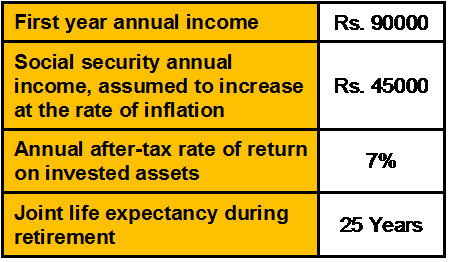
One commonly used method of calculating the total retirement fund necessary on the first day of retirement is to use the present value of an annuity due. The Pandeys' anticipate that their annual retirement income will need to increase each year at the rate of inflation. Based on the following assumption, calculate the total amount needed to be in place when Shanker and Parvati retire (Round to the nearest Rs. 1000)
Show Suggested Answer Hide Answer
Suggested Answer: C

Contribute your Thoughts:

0/2000 characters
Xuan
4 months ago
Can someone explain why we use annuity due instead of regular annuities?
upvoted 0 times
...
Lynelle
4 months ago
Definitely need to factor in inflation for accurate calculations.
upvoted 0 times
...
Helga
4 months ago
Wait, Rs. 1792000? That seems way too high!
upvoted 0 times
...
Cristal
4 months ago
I think Rs. 887000 sounds about right!
upvoted 0 times
...
Helaine
4 months ago
The present value of an annuity due is key for retirement planning.
upvoted 0 times
...
Carey
5 months ago
I feel like I should choose between Rs. 887000 and Rs. 896000, but I can't remember which one aligns with the calculations we practiced.
upvoted 0 times
...
Felicidad
5 months ago
I think the key here is to remember that the payments increase with inflation, but I'm a bit confused about how to apply that to the present value calculation.
upvoted 0 times
...
Joaquin
5 months ago
This question feels familiar! I think we did a similar one in class, but I can't recall the exact formula we used for the annuity due.
upvoted 0 times
...
Brittani
5 months ago
I remember we practiced calculating the present value of annuities, but I'm not sure if I got the inflation adjustment right for this scenario.
upvoted 0 times
...
Jovita
5 months ago
Ugh, I hate these annuity questions. They always seem to trip me up. Let me re-read the scenario and see if I can break it down step-by-step. Okay, I think I've got a plan now, but I'll need to work through it slowly and carefully.
upvoted 0 times
...
Kirk
5 months ago
This seems straightforward enough. I just need to plug the given values into the present value of an annuity due formula and do the calculation. As long as I don't make any silly mistakes, I think I can get the right answer.
upvoted 0 times
...
Albina
5 months ago
Hmm, I'm a bit unsure about how to approach this. I know it's related to annuities, but I'm not sure if I'm remembering the right formulas. I'll need to review my notes carefully before attempting this.
upvoted 0 times
...
Rosalyn
5 months ago
Okay, this looks like a present value of an annuity due calculation. I'll need to find the present value factor based on the given inflation rate and number of years, then multiply it by the annual retirement income to get the total amount needed.
upvoted 0 times
...
Michal
5 months ago
The duration and start/end dates make sense to me as being tied to the time policy. I'm a bit unsure about the other options, but I'll give it my best shot.
upvoted 0 times
...
Elke
5 months ago
I've seen this type of question before. The key is understanding what the target_rule cache is used for. I think I've got a good handle on this.
upvoted 0 times
...
Bobbye
5 months ago
I'm a bit confused by the details around the employees who left and are expected to leave. Do I need to account for that in the expense calculation, or just focus on the remaining employees?
upvoted 0 times
...
Edward
5 months ago
I'm confused about the MS120 models—didn't they have limitations on stacking, or was it just a particular version?
upvoted 0 times
...

Save Cancel